
New federally mandated Medicaid work reporting requirements are set to be implemented throughout the states by January 1, 2027. These requirements apply to adults ages 19–64 who have coverage through Medicaid expansion or an expansion-like program. Additionally, new federal mandates have also shortened the redetermination timeline for this population, changing from annual eligibility checks to six-month redeterminations.
Health policy experts estimate that millions of people across the U.S. could lose Medicaid coverage following the implementation of these mandates—coverage loss estimates range between 4.9 million and 10.1 million people. These new mandates also create new operational challenges for states, including increased administrative costs and requiring major updates to existing reporting systems.
At the same time, standard federal reporting alone does not capture the full picture. While it measures overall coverage losses, it does not identify the underlying reasons people lose coverage or the administrative hurdles that enrollees face.
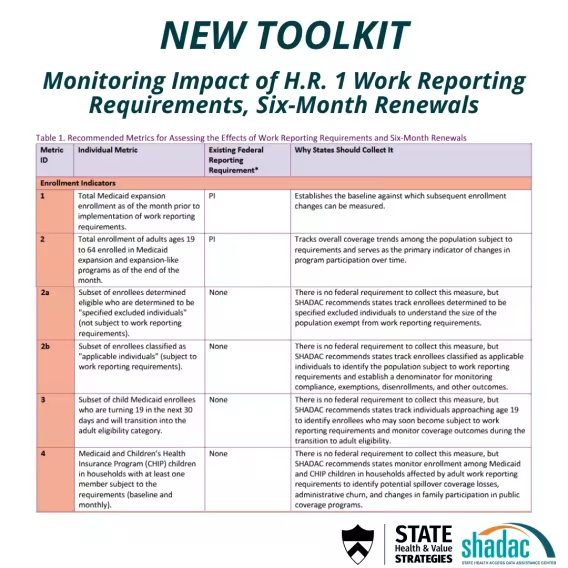
This new toolkit from SHADAC and State Health & Value Strategies can help in the work to understand state-level impacts of H.R. 1, providing states with a clear, organized monitoring framework that crosswalks new federal Medicaid work reporting requirements with existing reporting systems and identifies supplemental measures to help states monitor impacts beyond required federal reporting.
The toolkit includes:
Metrics to Track State-Level Impacts of Work Requirements
SHADAC organized the full crosswalk into an easy-to-digest table, categorizing the suggested H.R. 1 impact monitoring metrics into six distinct categories:
- Enrollment
- Application Processing
- Renewal and Redetermination
- Operations
- Coverage Transitions
- Fiscal Impacts
For each category, the toolkit lists individual metrics, indicates whether they are federally required, and explains of why states might consider collecting them. Beyond mandatory reporting, we also suggest additional metrics to help states monitor broader impacts, such as:
- spillover coverage losses and administrative churn on children
- documentation and verification barriers to coverage
- trends in Marketplace-to-Medicaid referrals
- administrative burden
- weak or failure points in the renewal process
Summary of Changes to T-MSIS Data Collection Requirements
States are also required align T-MSIS data collection and reporting to new federal guidelines, which will require many to make additional changes to their systems. The toolkit includes a section that reviews these changes and updates.
The Toolkit Is Available Now
Access and download the toolkit here. Questions about this work, the toolkit, or related monitoring activities? Contact SHADAC here.
SHVS has a number of related resources for states as they navigate H.R. 1 and work reporting requirement implementation and monitoring. Find other free, expert-developed resources here.