

Basics Blog
SHADAC has created a series of “Basics Blogs” to familiarize readers with common terms, concepts, and topics that are frequently covered. See all Basics Blogs here.
Opioids are a family of drugs that humans have used for thousands of years. These days, they are often used in health care, prescribed for purposes such as pain relief. They are also used illicitly for pleasurable feelings they can induce.
Whether used medically or abused for non-medical purposes, opioids have a high risk for addiction and dependence, as well as health risks including fatal overdoses, which can be seen reflected in the rise of the opioid crisis in the United States from the late 1990s to the present. In 2023 alone, 105,000 people in the U.S. died of an overdose with about 76% of those deaths involving opioids.
According to some of the most recent data, it’s estimated that over 6.1 million people in the U.S. have an opioid use disorder (OUD) — the medical term for an opioid addiction. While there are effective medical treatments for OUD, success often takes numerous attempts, with one study estimating that as many as 91% of those in recovery for OUD relapse (i.e., return to drug use after a period of stopping).
While there are other approaches to OUD treatment, such as “12-step” models and behavioral therapies, Medications for Opioid Use Disorder (MOUD) are evidence-based, effective treatments for OUD, with studies showing that they “substantially reduce overdose-related and overall mortality”.
So, what is opioid use disorder, exactly? How do medications for opioid use disorder work in the body? And how can MOUD help people recover from opioid addiction?
In a previous SHADAC blog, we explored common opioids, reviewing what opioids are and how their chemical structure and interaction in body have been foundational to the evolution of the opioid epidemic. In this blog, we will similarly explore MOUD, reviewing a definition for opioid use disorder, a list of currently approved MOUD, how these medications work, and current barriers for their access and use.
What Is Opioid Use Disorder?
While millions of people misuse opioids every year, not all of them qualify for a diagnosis of opioid use disorder (OUD), or an opioid “addiction.” OUD is a specific medical diagnosis added to the American Psychiatric Association’s Diagnostic and Statistical Manual of Mental Disorders (DSM) in 2013.
The CDC’s definition of Opioid Use Disorder (OUD) explains that OUD is “a problematic pattern of opioid use that causes significant impairment or distress. OUD is a treatable, chronic disease that can affect anyone – regardless of race, sex, income level, or social class.” In short, an OUD is characterized by a person compulsively using opioids despite it causing them health or social problems, such as with family or work responsibilities, or legal trouble. Some diagnostic criteria for OUD include:
- Opioids taken in larger amounts or over a longer time period than originally intended
- Cravings, strong desire to use opioids
- Opioid use that results in failure to fulfill work, social, school, and/or family obligations
- Withdrawal symptoms upon stopping use
- Persistent desire and/or unsuccessful attempts to stop, cut back, or control opioid use
- Increased tolerance to opioids (e.g., diminished effect with the same amount of opioid use, needing to increase opioid use amounts to achieve desired effect)
- Consistent use despite recurring or persistent physical and/or psychological problems caused (or exacerbated by) opioids
Only a medical professional can diagnose OUD, but as they rely on criteria such as those listed above, these examples can serve as signs that a person may benefit from assessment for and treatment of an opioid addiction.
What Are MOUD? Medications for Opioid Use Disorder
The chemical structure of opioids and the ways they affect the body makes them addictive. All opioids work by filling the “opioid receptors” found in various part of the human body. When opioid drugs fill and activate the opioid receptors in the brain, they can reduce sensations of pain, but they can also affect the brain’s natural “reward” circuits that cause a sensation of pleasure.
That phenomenon can trigger a cycle in which people may repeatedly use opioids to obtain those pleasurable feelings, but eventually the body can respond by reducing its production of natural endorphins that play a crucial role in a number of physiological functions. The result is “chemical dependence,” in which the body cannot operate normally without a person taking external opioids because their body has stopped producing enough endorphins on its own.
The chemical structure of opioids and the ways they affect the body can also make them risky and even deadly. The most dangerous side effect of opioid drugs is that they can suppress breathing. This is generally what causes serious injury in opioid overdoses—someone takes a large enough dose of opioids to stop or severely reduce their breathing rate, which can starve the body of oxygen, causing brain damage or even death. The proliferation of illicitly trafficked synthetic opioids, such as fentanyl, has only enhanced the risks of opioid abuse in recent years, as their relative potency makes them even more prone to causing overdoses than other, less-potent opioids.
While not the only option, one treatment for OUD with ample evidence supporting its effectiveness is use of Medications for Opioid Use Disorder, or MOUD. These medications are sometimes used as a standalone treatment method and are also often used alongside behavioral therapies and other supports.
What are MOUD? Medications for OUD are FDA-approved medications intended to help people stop or reduce their opioid use. Some MOUD can also help treat or reduce withdrawal symptoms and reduce drug cravings, which can help individuals who are trying to stop or reduce opioid use.
Numerous studies support the effectiveness of MOUD to reduce overdose mortality and related morbidity; for example, research shows that certain MOUD treatment can reduce deaths for people with OUD by up to 50%, decrease substance use, and improve physical and mental health. Studies also show that MOUD can help improve prevention and reduce spread of disease like HIV and Hepatitis C.
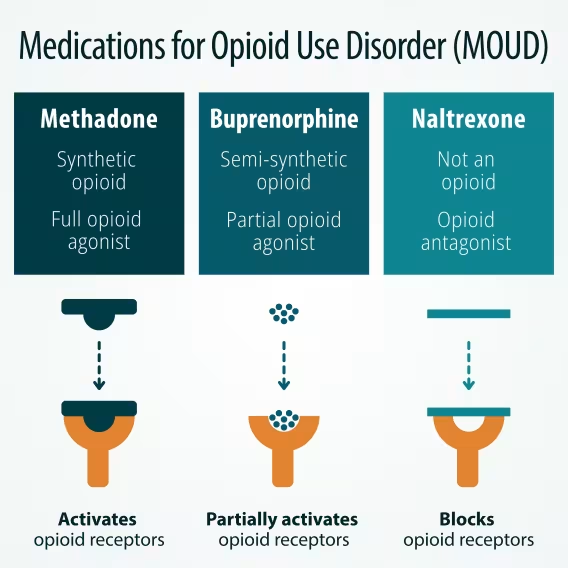
List of MOUD Approved by the FDA
Currently in the U.S., there are three main drugs (the main active ingredients found in multiple medications) approved by the Food and Drug Administration (FDA) to be used as MOUD:
- Methadone
- Buprenorphine
- Naltrexone
Each of these compounds works to treat OUD slightly differently based on its specific chemistry and how that impacts its interaction with the body. While some medications include combinations of these and other compounds, methadone, buprenorphine, and naltrexone are the three main active ingredients currently approved by the FDA for MOUD.
Now, we will look closer at each type of MOUD compound to understand how they work to treat OUD and related symptoms.
What Is Methadone and How Does It Work?
Methadone has been used to treat opioid addiction for over 50 years; it is actually a type of synthetic opioid known as a long-acting full opioid agonist. This means that like other opioid drugs, methadone binds to and activates opioid receptors in the brain.
However, unlike ”short-acting” opioids (e.g., fentanyl) that take effect and wear off relatively quickly, methadone is known as a “long-acting” opioid. Because of the unique chemistry of the compound, methadone typically remains in the body longer than other opioids and acts on opioid receptors over a longer period of time.
Additionally, medical providers have learned to dose methadone so that it won’t provide the euphoric “high” associated with other opioids when used for MOUD. The underpinning rationale for using methadone for MOUD is that by binding with the brain’s opioid receptors, it can prevent the “cravings” associated with opioid addiction and also prevent the unpleasant withdrawal symptoms associated with chemical dependence on opioids.
What Is Buprenorphine and How Does It Work?
Unlike methadone, buprenorphine is a type of semi-synthetic opioid, meaning it is not a naturally occurring compound but can be derived from the natural opioids found in the opium poppy. While it is also an opioid agonist, it is a partial agonist (compared to methadone, which is a full agonist).
What does that mean?
Full opioid agonists, like methadone or heroin, interact with and activate opioid receptors completely. Partial agonists like buprenorphine, on the other hand, also bind to and activate opioid receptors, but not completely; as their name suggests, they only partially fill and activate the receptor. This means that the effect of partial agonists like buprenorphine is weaker than that of methadone.
So while it can induce effects of other opioids, “with buprenorphine, […] these effects are weaker than full opioid agonists such as methadone and heroin. When taken as prescribed, buprenorphine is safe and effective,” the Substance Abuse and Mental Health Services Administration (SAMHSA) website explains.
Similar to methadone, buprenorphine helps to combat cravings and reduce physical dependence on opioids by filling the brain’s opioid receptors (even if only partially). By doing so, it helps to mitigate withdrawal symptoms, but it does not induce in a euphoric “high” when used as prescribed for MOUD.
Additionally, because this buprenorphine is less prone to the euphoria associated with fentanyl and many other full opioid agonists, it is generally regarded as having a lower potential for abuse and dependence.
What Is Naltrexone and How Does It Work?
Unlike methadone and buprenorphine, naltrexone is not an opioid. Naltrexone is what’s called an “opioid antagonist”. While all three of the MOUD compounds reviewed here bind to opioid receptors, naltrexone does not activate the receptors like methadone and buprenorphine do; naltrexone instead blocks opioid receptors from being activated at all.
If someone uses opioids while taking naltrexone, the opioids will not be able to bind or interact with the opioid receptors in the brain, meaning that users will not feel the euphoric or other effects of the drug, which can discourage use. Unlike methadone and buprenorphine, however, because naltrexone is not an opioid agonist, it cannot mitigate withdrawal symptoms.
According to the National Institute on Drug Abuse, naltrexone can be as effective as buprenorphine in helping people avoid relapse or drug use. However, because people are usually required to stop taking opioids for 7 to 10 days before starting naltrexone treatment, some may find it more difficult using naltrexone as MOUD.
Is Narcan a MOUD? Naloxone vs. Naltrexone
Similar in name, it can be easy to get naloxone and naltrexone confused. However, these two medications are distinct, and only naltrexone is used as MOUD. Naloxone, also known by the brand name Narcan, is not used for MOUD.
As we just reviewed, naltrexone is an opioid antagonist, blocking opioid receptors from being activated by opioids.
Naloxone is also an opioid antagonist, binding to and blocking opioid receptors from being activated by opioids. The difference with naloxone, though, is that it is used to “kick out” opioids that have already bound to receptors. This is what gives Narcan/naloxone the ability to help reverse overdoses as it can both block opioid receptors and remove opioids that were activating them — allowing the body to resume breathing normally again
MOUD Research and Access to Care Considerations
Despite the ample evidence that MOUD are effective treatment methods for those with OUD, studies estimate that almost 90% of people with OUD are not receiving these medications for treatment.
This is concerning: There are known, effective treatments for a medical condition linked not only to thousands of overdose deaths per year, but also to an epidemic that cost the United States $1.5 trillion in 2020 alone… but that treatment isn’t reaching the large majority of patients.
Why? One of the main issues is access. Certain communities (e.g., rural/smaller areas, those without reliable transportation) might not have anywhere near or accessible to them to receive a prescription for MOUD. Even if people can get a prescription, some pharmacies might not carry or dispense them, or it might take a long time to receive and fill a medication.
Studies also show that certain groups are disproportionately impacted by this lack of access, including, but not limited to, those in rural areas, women, those who are Black, those who are Hispanic, those who are unemployed, and adolescents.
Additionally, other types of access and utilization barriers can and do impact access to MOUD specifically, including: stigma associated with substance use and substance use disorder (among both patients and providers); lack of awareness and misconceptions about MOUD and their effectiveness; health insurance coverage related barriers (e.g., coverage issues for treatment, uninsurance, health care costs); disparities in treatment across demographic subgroups (e.g., race/ethnicity, sexual orientation, gender, etc.).
Further research and efforts to expand prescription, access, and use of MOUD such as these will be important for understanding how to get these life-saving and bettering medications into the hands of people who need them.
One pivotal step towards this goal was the ending of the Drug Enforcement Administration (DEA) X Waiver requirement, announced in December 2022. Prior to this change, health care providers were required to submit an X Waiver in order to prescribe buprenorphine for treatment of OUD. Removing this requirement was aimed at expanding buprenorphine access, allowing providers to prescribe this medication without that additional step. This reduced barriers that made it more difficult and time-consuming to prescribe this medication for treatment of OUD.
Another initiative out of the University of Minnesota School of Public Health in conjunction with Minnesota’s Opioid Epidemic Response Advisory Council is working to improve OUD workforce development and training for health care professionals, including an evaluation of MOUD prescription training for medical students and an expansion of training on MOUD treatment, harm and stigma reduction, and more.
Another related effort out of Pennsylvania, the PA MOUD Expansion Project, is funded in all counties in the state, working to implement and evaluate efforts and innovations for MOUD and OUD treatment, including EHR integration, MOUD performance measurement and quality improvement, capacity building, expansion of treatment to rural areas, and more.
Continue to stay up to date on the latest research relevant to the opioid epidemic on our resource page. Learn more about our work on Access to Care here, or sign up for our newsletter to get monthly updates straight to your inbox.