
A recent survey conducted by the Minnesota Department of Health (MDH) and the State Health Access Data Assistance Center (SHADAC) at the University of Minnesota found that almost half of Minnesotans have experienced health care discrimination.
The 2024 Minnesota Healthcare Experiences Survey was fielded to gain a better understanding of Minnesotans’ experiences of unfair treatment (also referred to as discrimination) in health care settings.
Key findings from the survey include:
- Nearly half of Minnesota survey participants (47.2%) reported they experienced discrimination while seeking health care services
- Some groups were more likely to experience discrimination compared to others—for example, 83.2% of surveyed transgender (trans) and nonbinary individuals experienced health care discrimination
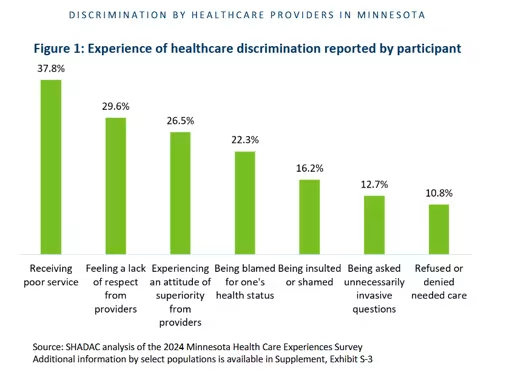
- The figure to the right the types of discrimination that were reported. The two most common reasons patients cited for discrimination were:
- Age-related discrimination (20.7%) and
- Body weight-related discrimination (20.2%)
- Types of discrimination differed across populations, though:
- Black, Indigenous, and People of Color were most likely to cite race-based discrimination (17.8%);
- Trans and nonbinary people were most likely to cite gender, gender identity, or sexual orientation-related discrimination (72.7%)
- Almost all who reported experiencing discrimination said it affected their mental health (95.0%); Nearly as many people (86.3%) believe their health care was negatively affected as well
- Roughly one-third of participants who experienced discrimination said it caused them to:
- Stop health care early (37.1%)
- Avoid seeking health care except in emergencies (33.6%)
You can read more details about these and other findings, along with details about the methodology, in the full report here.
About the Survey
The 2024 Minnesota Healthcare Experiences Survey is a follow-on study to the Minnesota Health Access Survey (MNHA). The Minnesota Health Access Survey (MNHA) is a large-scale web and telephone survey conducted every two years via a partnership between the Minnesota Department of Health (MDH) and the State Health Access Data Assistance Center (SHADAC) at the University of Minnesota.
Participants for this follow-on survey were recruited from a panel of Minnesotans who participated in the MNHA and agreed to be recontacted. Over 2000 participants completed the 2024 Minnesota Healthcare Experiences Survey in the spring of 2024 (either by phone or online).
While the results from the Experiences Survey were weighted to be representative of all adults in the state, both the panel characteristics—which were skewed towards more advantaged groups—and the small sample sizes of groups of Minnesotans most likely to experience discrimination make it more difficult to generalize these findings to the entire Minnesota population.
Thus, while the Experiences Survey does provide important data from study participants, adding depth and range to understanding discrimination in health care, it should not be interpreted as applying to all Minnesotans or being completely representative of every population group. Learn more about the survey’s design and limitations in the full report here.
Using Surveys to Understand Health and Health-Related Topics
Interested in learning more about using surveys to understand health care access, how the health care system can influence health, and related topics like care utilization and affordability?
If so, check out some of the following SHADAC resources:
- Explore data on over 40 different measures of health on State Health Compare
- Resource: State Survey Research Activity
- Project: State Solutions for Health Data Continuity