
State Solutions for Health Data Continuity
Health policy development in the United States relies on evidence-based decisionmaking supported by a federal data infrastructure.
For decades, states have relied on federal survey systems, such as the American Community Survey (ACS), the Behavioral Risk Factor Surveillance System (BRFSS), and the National Survey of Children’s Health (NSCH), to provide cornerstone estimates needed to design and improve Medicaid programs, regulate insurance markets, and target public health interventions. These data have long been seen as the "gold standard," providing the best means for national benchmarking, 50-state comparisons, and identifying and addressing the geographic and demographic disparities.
However, recent volatility in federal data management has resulted in concerns about whether the federal government will continue to collect and publish critical data sources used by researchers, policymakers, and other stakeholders.
In response to these and other concerns regarding the future of federal data infrastructure, collection, quality, and investment, SHADAC launched a project called State Solutions for Health Data Continuity. With support from the Robert Wood Johnson Foundation, this project seeks to study and develop practical solutions for filling state health data gaps.

Specifically, the project seeks to mitigate the impacts of federal data uncertainty by fostering a community of state data users through action-oriented workgroup convenings, individualized technical assistance, and the sharing of timely information and key resources.
Keep reading to learn more about this project.
Looking for this project’s publications? Click here to jump to a list of all blogs, tools, and resources created for this project.
Do you have a state data question? Need technical assistance? We can help—contact SHADAC here with your question or technical assistance request and one of our experts will reach out.
Project Overview
SHADAC’s State Solutions for Health Data Continuity project has three overarching aims:
- To assess vulnerabilities and identify critical gaps in state-focused health data if federal surveys are eliminated or investments are reduced.
- To understand the feasibility of various state alternatives or options for filling those potential state-level data gaps to ensure high-quality health data remains available for research, decisionmaking, and more.
- To sustain the vital connection between state health data professionals and the technical expertise they require through the formation of action-oriented workgroups and by providing individualized technical assistance.
Individualized Technical Assistance (TA)
Alongside concerns regarding potential loss of survey data itself through the elimination of surveys or specific variables, SHADAC has identified a more subtle, but equally damaging, issue in the current data landscape: the erosion of the federal technical support that makes federal health survey data usable. We found that state policymakers, researchers, and advocates rely on federal agencies not just for data, but as hubs for methodological and technical guidance, standards, and innovation.
As such, SHADAC aims to serve as a key resource for technical assistance and support for health data professionals using federal survey data, engaging in state survey data collection, or doing state policy work that relies on data.
While these requests vary greatly depending on the topic and stakeholder, and will evolve as the federal data landscape does, we imagine requests for TA will likely fall into the following areas:
- Data Navigation and/or Alternatives
- Support for Primary Data Collection
- Data Quality Assurance
- Addressing Methodological Challenges
- Analysis and/or Coding Support
- Data Access and/or Compliance Support
- And More
Do you need assistance with data analysis, collection, methods, or something else? Contact SHADAC with your request here.
Action-Oriented Workgroup Convenings
Given the vast network of state data professionals and wide scope of ongoing challenges, SHADAC recognizes the need for collaborative problem solving. To support this, SHADAC will establish, convene, and facilitate a series of virtual workgroups.
These forums of interested and invited participants will center around a specific topic, strategy, or health domain, with workgroups identifying data concerns and technical barriers, mapping out fixes, and working to standardize or align solutions across states, where appropriate.
Some examples of possible workgroups include:
- Leveraging state surveys as an alternative data source
- Methods for enhanced quality assessment of federal data
- Strategies for using non-survey data to address critical gaps
Alongside direct collaboration and community problem solving, we aim to disseminate key learnings, alternatives, and solutions generated from these workgroups to the broader data and health policy community. Learn more about resources created and disseminated for this project here.
Gathering Workgroup Feedback via Interactive Virtual Meeting
To initiate these workgroup convenings, SHADAC hosted a public virtual meeting on Tuesday, June 23, 2026, called, “State Solutions for Health Data Continuity: Collaborating to Fill Emerging Federal Data Gaps”.
In this interactive meeting, we shared key findings from discussions with experts on current challenges to federal survey data and potential alternatives. We dedicated most of this meeting to gathering feedback and information from attendees via polling and discussion in order to align SHADAC’s upcoming workgroups with stakeholder needs and priorities. The slides from this meeting can be found here or by clicking the image of the cover slide below.
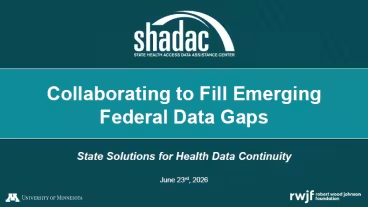
Learn more about this meeting here. Interested joining one of the workgroups? Contact SHADAC for more information and to express interest in these upcoming workgroups.
Survey Data Finder
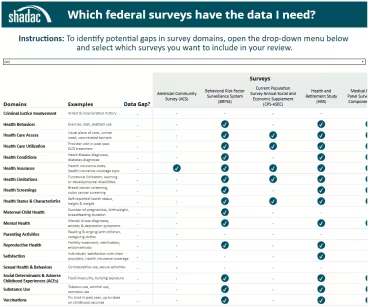
To support state data users as they navigate changes in access to federal survey data we created an interactive tool: the Survey Data Finder.
This resource is designed to help data users identify where they may be able to obtain data needed for public health and health policy purposes, including research, policy analysis, advocacy, or other uses. A unique feature of the Survey Data Finder tool is that it can be used to identify whether there are, or would be, any gaps in health domains among the surveys that a user selects.
Learn more about the tool and how to use it here.
We also created a blog (“A Brief Overview of Several Federal Health-Related Surveys”) as a companion to the tool with summaries of each of the surveys included.
Strategy Brief Series: Actionable Strategies for State Data Professionals Navigating Federal Data Gaps
To help state data users adapt to a changing federal data landscape, SHADAC developed a series of Strategy Briefs. These briefs are designed to provide data users with alternatives for filling potential emerging data gaps, with each brief providing a high-level roadmap of an alternative data strategy, including its advantages, disadvantages, and implementation considerations.
The gap-filling strategies we describe in these briefs include the following:
- Investment in State Surveys
- Leveraging Electronic Health Record Data to Complement Data from Federal Surveys
- Leveraging Health Insurance Claims Data to Complement Data from Federal Surveys
Click on any of those links above to read each strategy's full brief. You can also find all of the Strategy Briefs created by SHADAC on this resource page, which is also linked below in the "Resources" section.
Resources
The insights gathered from this project have value to the broader public health and health policy community, and we are committed to making this information accessible to a wide spectrum of data users and stakeholders.
Below, you'll find a list of resources we have created as a part of this project. We will update this page periodically as the project moves forward.
Brief Series, June 2026: Actionable Strategies for State Data Professionals Navigating Federal Data Gaps
Blog, February 2026: Sexual Orientation and Gender Identity (SOGI) Data Collection and Availability in Federal Health Surveys and Beyond
Blog, January 2026: Examples of Federal Health Data Preservation Efforts Across the U.S.
Blog, January 2026: Taking the Pulse of the Nation’s Households: The Value of Real-Time Survey Data During an Era of Rapid Policy Change
Resource / Tool: Survey Data Finder, Interactive Tool
Blog, November 2025: A Brief Overview of Several Federal Health-Related Surveys
Blog, November 2025: The Landscape of Major Federal Health Survey Data Releases in 2025
Blog, September 2025: The Unique Role of Federal Surveys for Measuring Child and Adolescent Health
Blog, August 2025: Navigating a Path Forward Through Health Data Uncertainty
Last updated June 30, 2026.