
Nearly 14 million adults in the United States identify as part of the LGBT (Lesbian, Gay, Bisexual, Transgender) community—more than the entire population of Pennsylvania.[1],[2] While research is limited, studies continually find that LGBT people are more likely to experience health, economic, and social disparities than non-LGBT peers.
For example:
- Behavioral Risk Factor Surveillance System (BRFSS) data shows that about 22% of LGBT people live in poverty compared to 16% of non-LGBT people, with rates even higher for certain LGBT individuals, including transgender people experiencing poverty at a rate of 29.4%.[3]
- A KFF survey found that “LGBT adults face higher rates of discrimination […] compared to non-LGBT adults, including in health care settings”.[4]
- A MACPAC study using National Health Interview Survey (NHIS) data found that lesbian, gay, and bisexual adults covered by Medicaid are significantly more likely to report having a mental illness (compared to heterosexual adults) and to have not received needed treatment for their mental illness in the past 12 months.[5]
These and other findings use what is called sexual orientation and gender identity (SOGI) data in order to better understand LGBT Americans’ experiences with health, the health care system, and related factors such as poverty, discrimination, mental health, and more.
However, recent federal policy changes have created uncertainty surrounding both the availability of SOGI data that has already been collected, and whether SOGI data collection will continue to be collected (and in what form) in federal and other data sources.
This blog post will review the current known status of SOGI data in federal surveys and programs; this information was gathered during SHADAC’s overall data monitoring efforts and as a part of our State Alternatives for Health Data Continuity project supported by the Robert Wood Johnson Foundation.
What Are SOGI Data?
SOGI is an acronym for Sexual Orientation and Gender Identity; SOGI data is information on the sexual orientation and/or gender identity of individuals, and can be collected on surveys, administrative forms, medical forms, and more.
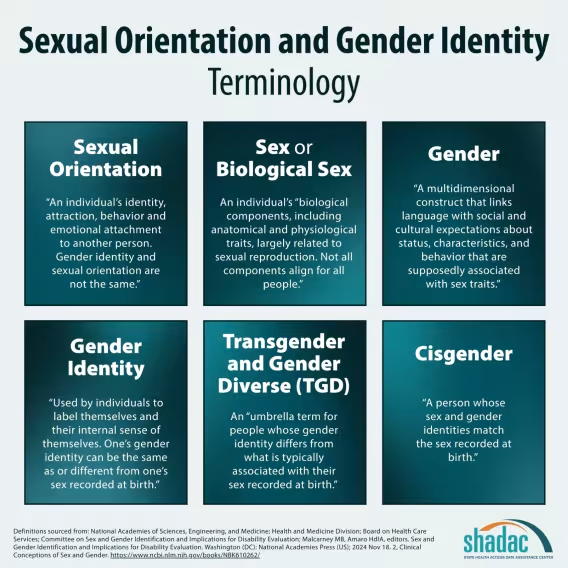
Sexual Orientation and Gender Identity Terminologyi
Sexual Orientation is “An individual’s identity, attraction, behavior and emotional attachment to another person. Gender identity and sexual orientation are not the same.”
Sex or Biological Sex refers to an individual’s “biological components, including anatomical and physiological traits, largely related to sexual reproduction. Not all components align for all people.”
Gender is “A multidimensional construct that links language with social and cultural expectations about status, characteristics, and behavior that are supposedly associated with sex traits.”
Gender Identity is “used by individuals to label themselves and their internal sense of themselves. One’s gender identity can be the same as or different from one’s sex recorded at birth.”
Transgender and Gender Diverse (TGD) is an “umbrella term for people whose gender identity differs from what is typically associated with their sex recorded at birth.”
Cisgender refers to “a person whose sex and gender identities match the sex recorded at birth.”
[i] Definitions sourced from: National Academies of Sciences, Engineering, and Medicine; Health and Medicine Division; Board on Health Care Services; Committee on Sex and Gender Identification and Implications for Disability Evaluation; Malcarney MB, Amaro HdlA, editors. Sex and Gender Identification and Implications for Disability Evaluation. Washington (DC): National Academies Press (US); 2024 Nov 18. 2, Clinical Conceptions of Sex and Gender. https://www.ncbi.nlm.nih.gov/books/NBK610262/
Federal, State SOGI Data Collection: Brief History
Sex (i.e., male, female) has been collected on various types of surveys for many years, dating back to the first iteration of the census in 1790. However, collection of detailed sexual orientation and gender identity data is a relatively new endeavor for many federal and state agencies.
According to the Congressional Research Service, “the federal government collected data relating to sexual orientation as early as 2001 in several surveys, including the Centers for Disease Control and Prevention’s National Health and Nutrition Examination Survey and National Health Interview Survey (NHIS).”[6]
Some states, including Massachusetts and Oregon, have been on the cutting edge of incorporating sexual orientation and gender identity data collection: Massachusetts added data collection to their BRFSS for sexual orientation in 2001 and for gender identity in 2007; Oregon passed legislation in 2021 for Medicaid Accountable Care Organizations, health care providers, and health insurers to collect race, ethnicity, language, and disability (REALD) data along with SOGI data for patients, members, etc. at least once a year.
However, until recently, there were no efforts to standardize SOGI data collection at the federal level (e.g., question format, wording, or guidance). Lack of standards have resulted in varied collection efforts, which has made consistent data collection, reporting, and comparison difficult.
SOGI Data Collection Standardization and Guidance: 2022–2024
The landscape changed in 2022 with a series of Biden Administration Executive Orders and reports, which directly addressed SOGI data collection in Executive Order No. 14075 (2022), Advancing Equality for Lesbian, Gay, Bisexual, Transgender, Queer, and Intersex Individuals. Amongst other directives, Sec. 11 of this order states:
“Promoting Inclusive and Responsible Federal Data Collection Practices. (a) Advancing equity and full inclusion for LGBTQI+ individuals requires that the Federal Government use evidence and data to measure and address the disparities that LGBTQI+ individuals, families, and households face, while safeguarding privacy, security, and civil rights.”[7]
Executive Order No. 14075 also established a subcommittee on SOGI data working to improve, implement, and coordinate federal collection of these data. The work from this resulted in a report published by the Office of Management and Budget (OMB) and the Chief Statistician, titled Recommendations on the Best Practices for Collection of Sexual Orientation and Gender Identity Data on Federal Statistical Surveys and was followed by agency-specific data collection guidance.
Another report by the Subcommittee on SOGI Data and the Subcommittee on Equitable data was published in January 2023, titled Federal Evidence Agenda on LGBTQI+ Equity. This report reviewed LGBT data needs, including information on the collection and publication of SOGI data, and offered some guidelines for collecting SOGI data on forms or in other administrative processes.
On September 29, 2023, the Centers for Medicare and Medicaid Services (CMS) released “a proposed model [Medicare] enrollment form for MA and Part D plans that includes a sex assigned at birth question and a gender identity question, in addition to questions about sexual orientation, race, and ethnicity.”[8]
In a separate informational bulletin, CMS announced that starting November 1, 2023, individuals applying for coverage through HealthCare.gov would be asked new optional questions on the topic of SOGI.[9] CMS also provided guidance for states looking to add these SOGI questions to their state’s Medicaid and CHIP applications, stating that, “States are not required to add the SOGI questions to their Medicaid and Children’s Health Insurance Program (CHIP) applications but have the option to do so consistent with this guidance.”[9]
And, in 2024, the U.S. Census Bureau’s American Community Survey—the largest household survey in the U.S.—began testing SOGI questions for inclusion.[10] Together, these efforts combined seemed to signal a new federal focus on coordinated and enhanced SOGI data collection.
Post-2024 Changes to Federal SOGI Data Collection
Since the beginning of 2025, the landscape of SOGI data collection has shifted again, marking a departure from previous federal policy. Following the recission of the Biden Administration’s EO 14075, which had previously expanded SOGI data collection efforts, a new Executive Order No. 14168 (2025), titled Defending Women From Gender Ideology Extremism and Restoring Biological Truth to the Federal Government, redefines how federal agencies approach sex and gender identity data.
Section 2 of this Executive Order states:
“(a) “Sex” shall refer to an individual's immutable biological classification as either male or female. “Sex” is not a synonym for and does not include the concept of “gender identity.”
(b) “Women” or “woman” and “girls” or “girl” shall mean adult and juvenile human females, respectively.
(c) “Men” or “man” and “boys” or “boy” shall mean adult and juvenile human males, respectively.
(d) “Female” means a person belonging, at conception, to the sex that produces the large reproductive cell.
(e) “Male” means a person belonging, at conception, to the sex that produces the small reproductive cell.
(f) “Gender ideology” replaces the biological category of sex with an ever-shifting concept of self-assessed gender identity, permitting the false claim that males can identify as and thus become women and vice versa, and requiring all institutions of society to regard this false claim as true.
Gender ideology includes the idea that there is a vast spectrum of genders that are disconnected from one's sex. Gender ideology is internally inconsistent, in that it diminishes sex as an identifiable or useful category but nevertheless maintains that it is possible for a person to be born in the wrong sexed body.
(g) “Gender identity” reflects a fully internal and subjective sense of self, disconnected from biological reality and sex and existing on an infinite continuum, that does not provide a meaningful basis for identification and cannot be recognized as a replacement for sex.”[11]
It later states that “federal funds shall not be used to promote gender ideology” and that:
“Agencies shall remove all statements, policies, regulations, forms, communications, or other internal and external messages that promote or otherwise inculcate gender ideology, and shall cease issuing such statements, policies, regulations, forms, communications or other messages. Agency forms that require an individual's sex shall list male or female, and shall not request gender identity. Agencies shall take all necessary steps, as permitted by law, to end the Federal funding of gender ideology.”[11] (Sentence bolded by the authors of this blog to highlight the portion most relevant to SOGI data.)
Additionally, a memorandum was sent on January 29, 2025, from the Acting Director of the U.S. Office of Personnel Management to heads and acting heads of agencies instructing them to comply with EO 14168 including, amongst other directives, to “Take down all outward facing media (websites, social media accounts, etc.) that inculcate or promote gender ideology” and “Review all agency forms that require entry of an individual’s sex and ensure that all list male or female only, and not gender identity. Remove requests for “gender” and substitute requests for “sex””.[12]
While hundreds of federal agency webpages, sites, documents, data sets, and more were removed or taken down following these orders and directives, many of these have since been restored following a lawsuit.[13] However, some of these restored data, documentation, reports, etc., had “certain sociodemographic variables […] removed from some datasets or reports, including racial and ethnic and gender identity data”, according to a review from KFF.[14]
Current Federal SOGI Data Collection and Availability
Below, we detail known information on changes or updates to SOGI data collection on federal health surveys and in two major federal health programs (Medicaid and Medicare).
It is important to note that the current status of SOGI data collection, documentation, and data files varies by survey, and, in many cases, remains uncertain based on publicly available information at the time of writing. Limited documentation of these changes exists publicly; along with gleaning information from reviews, research, and reports from other organizations, SHADAC also relied on reviewing survey forms, questionnaires, and documents to see whether SOGI data collection was included or removed. We welcome any feedback on this summary—contact us here.
American Community Survey (ACS)
In late 2024, the American Community Survey (ACS) had started testing SOGI questions, with implementation of the questions tentatively planned for the 2027 ACS.[10]
However, planned SOGI data collection in the ACS now appears uncertain in light of changing federal policy. It is possible that future gender identity data collection will not occur, and existing gender identity information could be removed from datasets. We will continue to monitor information or updates on ACS SOGI data collection.
Behavioral Risk Factor Surveillance System (BRFSS)
BRFSS is jointly run by states and the Centers for Disease Control and Prevention (CDC). In February 2025, a STAT article reported that, according to a CDC representative, “The Centers for Disease Control and Prevention will no longer process transgender identity data in order to comply with President Trump’s executive order.”[15] The article goes on to report that “Sexual orientation data is unaffected and ‘will be processed per usual protocols,’” according to the interviewed CDC representative.
Information about gender identity has been removed from BRFSS data files and documentation, including changing the “gender” variable to be called “sex” instead, and a KFF review finding questions “related to gender and gender identity have also been removed from recent BRFSS data, including questions about respondents’ sex at birth and whether they identify as transgender”.[14]
The CDC reportedly no longer processing transgender identity data combined with removal of questions related to gender identity from recent BRFSS data suggests that gender identity data collection has likely been discontinued in the BRFSS.
Household Trends and Outlook Pulse Survey (HTOPS)
The HTOPS, a new iteration of the Census Bureau’s Household Pulse Survey, appears to have discontinued gender identity data collection.
According to a “Non-Substantive Change Request Submission” document submitted in February 2025 for the HTOPS, “The U.S. Census Bureau is requesting a change request to revise questions to align with E.O. 14168 Defending Women From Gender Ideology Extremism and Restoring Biological Truth to the Federal Government.”[16] These changes included both revising a question (specifically, “replaced sex at birth with sex”) and the removal of five questions related to gender identity.
National Health Interview Survey (NHIS)
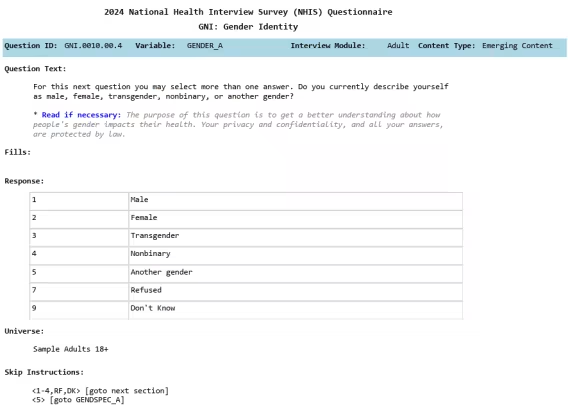
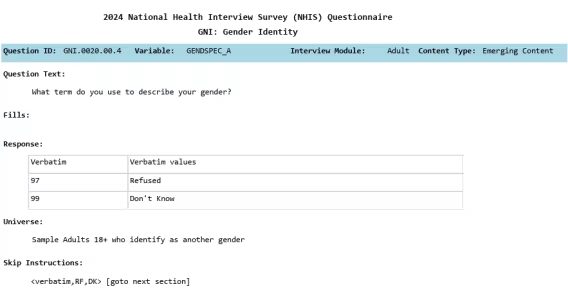
In the 2024 National Health Interview Survey (NHIS) questionnaire, questions on both sexual orientation and gender identity were included; both questions included a follow-up question for those who answered “something else” or “I don’t know” to sexual orientation, and for those who answered “another gender” to gender identity.[17]
Figure 1. 2024 National Health Interview Survey (NHIS) Questionnaire, Sexual Orientation Questions
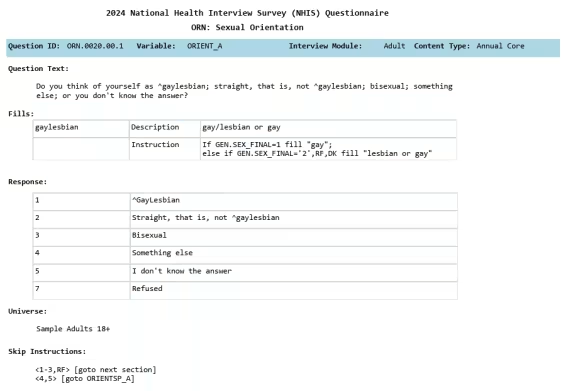
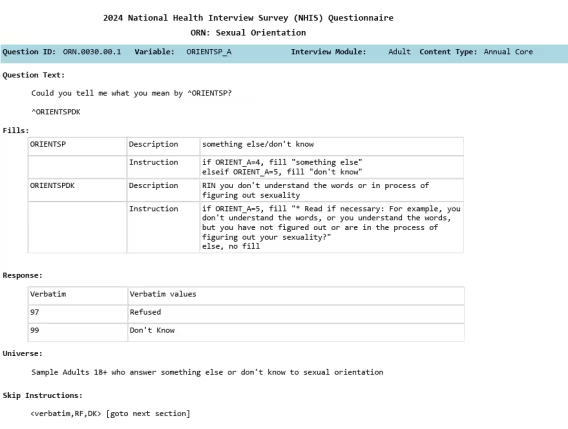
Figure 2. 2024 National Health Interview Survey (NHIS) Questionnaire, Gender Identity Questions
In the 2025 NHIS questionnaire, sexual orientation questions were included, but the gender identity questions were removed.[18]
Figure 3. 2025 National Health Interview Survey (NHIS) Questionnaire, Sexual Orientation Questions
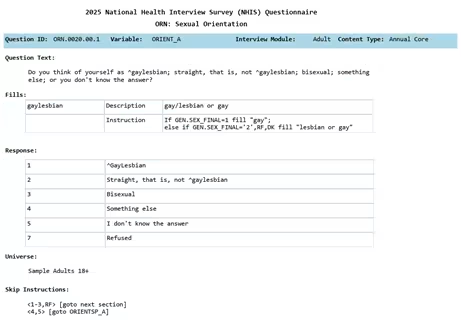
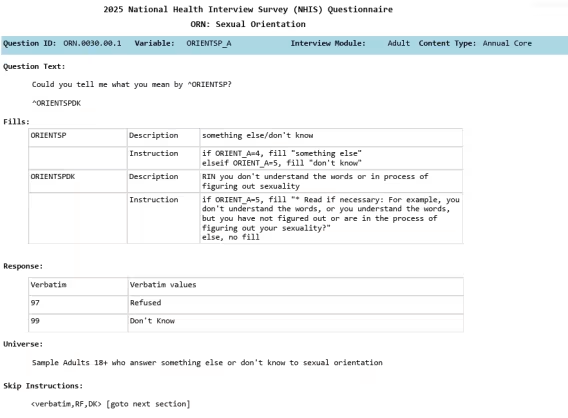
A review from KFF in December 2025 also details how questions on sexual orientation in the NHIS had not been changed at the time of writing, but the question asking about gender identity (and its follow-up question) had been removed from the survey.[19]
As such, gender identity data collection appears to be discontinued on the NHIS.
National Survey of Children’s Health (NSCH)
The National Survey of Children’s Health (NSCH) began asking a SOGI-related question around 2020, specifically as part of a question that asks about the child’s experience with adverse childhood experiences (also known as ACEs). The NSCH is designed “to be completed by a parent or caregiver of [a] selected child” and includes “specific questions [that] were tailored to be relevant to children in [each] age range.”[20] Surveys for children age 6–17 asked, amongst other experiences, whether they had been “treated or judged unfairly because of their sexual orientation or gender identity” with available responses as “Yes” and “No”.[21]
While it is still possible to find some data from this question (for example, from the Child and Adolescent Health Measurement Initiative’s 2022 NSCH ACEs estimates), it appears that some NSCH documents are missing references to the SOGI part of the ACEs question. For example, users cannot find this question when searching on the survey’s “Interactive Data Query” search tool or on the Guide to NSCH Changes Across Survey Years webpage.
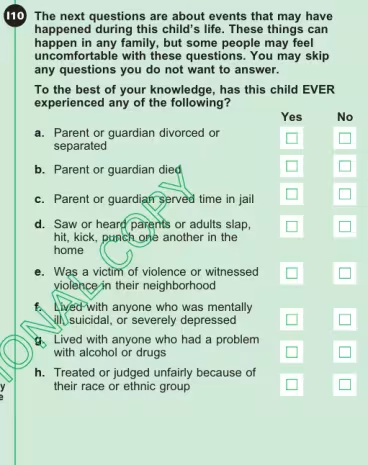
When examining pre-2025 versions of NSCH questionnaires archived by the Internet Archive, we can see how the SOGI part of the question has been removed in current versions. For example, comparing an archived version of the NSCH 2020 Topical Questionnaire (Children, 6-11 years) (archived in 2024) to the version of the NSCH 2020 Topical Questionnaire (Children, 6-11 years) currently on both the Maternal and Child Health Bureau website and the Census website shows that the SOGI part of this question (“i. Treated or judged unfairly because of their sexual orientation or gender identity”) has been removed in the current versions compared to the version archived in 2024:[21],[22]
Figure 4. 2020 NSCH Question I10, Internet Archive, Version Archived November 20, 2024
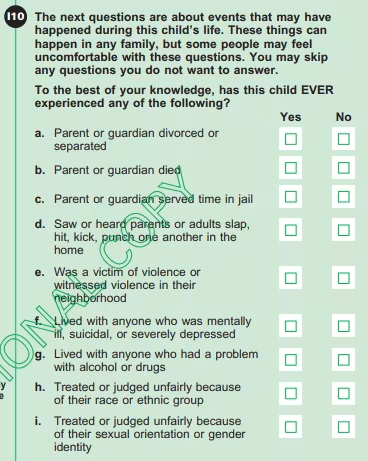
Figure 5. 2020 NSCH Question I10, Version on Census Website as of February 2, 2026
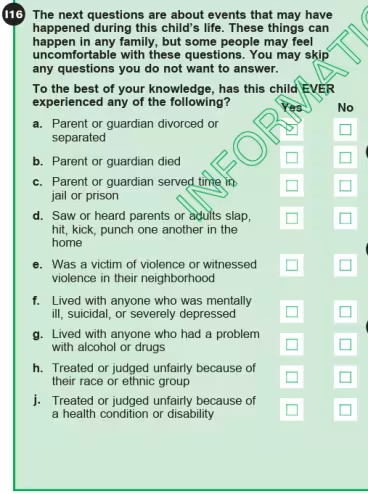
One can also see this removal on other versions of the NSCH questionnaire: Comparing an archived version of the 2024 NSCH Topical Questionnaire (Children, 6-11 years) to the version of the same document on the Census website, we can see that the currently available version removed the SOGI part of the question (“i. Treated or judged unfairly because of their sexual orientation or gender identity”) with a clear jump from “h.” to “j.” after the removal of “i.”:[23],[24]
Figure 6. 2024 NSCH Question I16, Internet Archive, Version Archived February 6, 2025
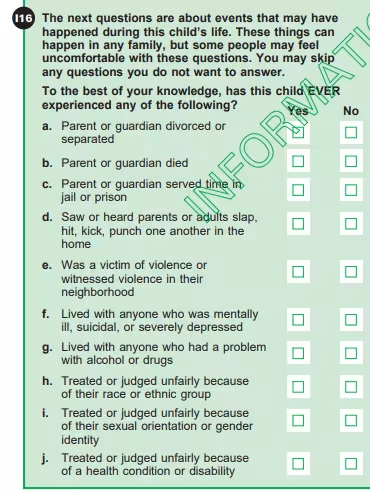
Figure 7. 2024 NSCH Question I16, Version on Census Website as of February 2, 2026
Codebooks for data users for the NSCH also lack any reference to variable based on the question about being “treated or judged unfairly because of their sexual orientation or gender identity” even in data years where it was asked.[25]
Youth Risk Behavior Surveillance System (YRBSS)
Like the similarly named BRFSS, the Youth Risk Behavior Surveillance System (YRBSS) is jointly run by the CDC with assistance from other jurisdictions and agencies, such as states and schools. It entails surveys of high school students in grades 9 through 12.[26]
According to a report from the CDC, “Questions ascertaining sexual identity and sex of sexual contacts have been included in some state and school district YRBSs since 1995. Beginning in 2015, a question asking about sexual identity and a question asking about sex of sexual contacts was added for the first time to the standard questionnaire used by the states and local school districts and to the national YRBS questionnaire. In 2021, the sexual identity question was revised to add a few new response options.”[27] Another CDC webpage states that, “For the first time, the 2023 national Youth Risk Behavior Survey (YRBS) asked students whether they identify as transgender (those whose gender identity differs from their sex assigned at birth).”[28]
Both the sexual orientation and transgender identity questions appear on the latest versions of the 2025 high school YRBS questionnaires currently on the CDC website; however, as we referenced earlier, STAT reported that the CDC is no longer processing transgender identity data.[15],[29] Also according to that article from STAT, the CDC representative they spoke to “did not respond to questions about how exactly the survey would be modified,” but the article’s author goes on to state that “it’s likely that the question on the standard YRBSS about transgender identity is being removed. State-level public health workers with knowledge of the YRBSS process told STAT they’d heard the CDC will not support data aggregation on the question if states choose to include them in their separate, local surveys.”[15]
As of the time of this writing, the future of transgender or gender identity data collection in the YRBSS appears uncertain—while reference to the question still exists online in questionnaires, reports, and other documents, it’s been reported that the CDC is no longer processing transgender identity data, making continued or future collection or analysis of gender identity data in this survey unlikely.
CMS: SOGI Data in Medicaid and CHIP Applications, Medicare
While not survey data, we think it important to note changes to data collection in Medicaid, CHIP, and Medicare; changes were made to these federal programs’ SOGI data collection after Executive Order No. 14168. Such data are often used in similar ways by researchers and policymakers to understand critical health issues.
On February 12, 2025, CMS released a Health Plan Management System (HPMS) memo stating it would remove SOGI questions from Medicare enrollment forms: “CMS will remove the voluntary Sexual Orientation and Gender Identification (SOGI) questions from the Model C/D and LINET enrollment forms.”[30]
In a separate memo from May 2025, CMS further specified: “On February 12, 2025, CMS announced […] that plans will no longer be required to collect and submit voluntary sexual orientation and gender identity responses on enrollment transactions in accordance with Executive Order 14168 (“Defending Women From Gender Ideology Extremism and Restoring Biological Truth to the Federal Government”). Plans are expected to remove any voluntary sexual orientation and gender identity questions from their MA and Part D enrollment forms as soon as possible. Plans should not submit forms with the voluntary sexual orientation and gender identity questions and response options to CMS for review. The plans will also be required to submit a valid sex code (formerly known as gender code) on the Transaction Code 61 Enrollment.”[31]
Additionally, on June 5, 2025, CMS issued a bulletin rescinding its guidance on including SOGI questions in state Medicaid and CHIP applications.[32] This bulletin also announced that CMS does not plan to collect this information as part of Transformed Medicaid Statistical Information System (T-MSIS) submissions.
Other Sources of SOGI Data and Information
There are other surveys, data sources, and resources available for those looking for sexual orientation and gender identity data and information. These include:
Health Data Continuity—Stay Updated with SHADAC
There are millions of Americans that identify under the LGBT umbrella, with ample evidence suggesting that sexual orientation and gender identity are factors clearly relating to health.[33]
Even prior to recent federal changes, health-related data on LGBT populations was not particularly robust. For example, even though research has shown that LGBT adults are more likely to rely on Medicaid as a primary source of coverage compared to non-LGBT adults, MACPAC’s federal survey sample size analysis found that only four of the thirteen surveys tested could support analysis for lesbian, gay, or bisexual individuals on Medicaid.[34] The same analysis found that only two of the surveys studied asked for or collected information on gender identity, and only one survey could support analysis for transgender, gender non-conforming, or non-binary Medicaid enrollees.
Uncertainty and impacts from changes in SOGI data collection at the federal level could widen this already existing gap in LGBT data. Continued monitoring and reporting on the availability of federal SOGI data will be essential for helping those seeking to use SOGI data for health and policy research.
We welcome feedback and additional details on the information provided in this post; contact us here or send us an email at [email protected].
Stay up-to-date with SHADAC’s latest related resources by checking our State Alternatives for Health Data Continuity project page, and by signing up for our monthly newsletter. You can also follow us on LinkedIn for more frequent updates.
Sources
[1] UCLA Williams Institute. (n.d.). Quick Facts: LGBT FAQs. Retrieved February, 2026, from https://williamsinstitute.law.ucla.edu/quick-facts/lgbt-faqs/
[2] U.S. Census Bureau. (n.d.). QuickFacts: Pennsylvania. Retrieved February, 2026, from https://www.census.gov/quickfacts/fact/table/PA/SBO040217
[3] Siers-Poisson, J. (2021, June). The Complexity of LGBT Poverty in the United States. University of Wisconsin-Madison, Institute for Research on Poverty. https://www.irp.wisc.edu/resource/the-complexity-of-lgbt-poverty-in-the-united-states/
[4] Montero, A., Hamel, L., Artiga, S., & Dawson, L. (2024, April 2). LGBT Adults’ Experiences with Discrimination and Health Care Disparities: Findings from the KFF Survey of Racism, Discrimination, and Health. KFF. https://www.kff.org/racial-equity-and-health-policy/lgbt-adults-experiences-with-discrimination-and-health-care-disparities-findings-from-the-kff-survey-of-racism-discrimination-and-health/
[5] Medicaid and CHIP Payment and Access Commission (MACPAC). (2022, June). Access in Brief: Experiences of Lesbian, Gay, Bisexual, and Transgender Medicaid Beneficiaries with Accessing Medical Care and Behavioral Health Care. https://www.macpac.gov/publication/access-in-brief-experiences-of-lesbian-gay-bisexual-and-transgender-medicaid-beneficiaries-with-accessing-medical-care-and-behavioral-health-care/
[6] Knoedl, T.R. (2024, April 2). Proposed Expanded Collection of Statistics on Sexual Orientation and Gender Identity by the Federal Government. Congressional Research Service. https://www.congress.gov/crs_external_products/IN/PDF/IN12342/IN12342.1.pdf
[7] Executive Office of the President. (2022, June 21). Exec. Order No. 14075, Advancing Equality for Lesbian, Gay, Bisexual, Transgender, Queer, and Intersex Individuals. 87 FR 37189, Pages 37189-37195. https://www.federalregister.gov/documents/2022/06/21/2022-13391/advancing-equality-for-lesbian-gay-bisexual-transgender-queer-and-intersex-individuals
[8] National Academies of Sciences, Engineering, and Medicine; Health and Medicine Division; Board on Health Care Services; Committee on Sex and Gender Identification and Implications for Disability Evaluation. (2024, November 18). Sex and Gender Identification and Implications for Disability Evaluation: 4. Data on Sex and Gender Identity: Collection Across the U.S. Health Care System. Editors Malcarney, M.B. & Amaro, H.A. https://www.ncbi.nlm.nih.gov/books/NBK610249/
[9] Tsai, D. (2023, November 9). CMCS Informational Bulletin: Guidance on Adding Sexual Orientation and Gender Identity Questions to State Medicaid and CHIP Applications for Health Coverage. Center for Medicaid and CHIP Services; Centers for Medicare and Medicaid Services. https://www.hhs.gov/guidance/sites/default/files/hhs-guidance-documents/AID/cib11092023.pdf
[10] Galvin, S. (2024, November 7-8). Testing and Implementing Sexual Orientation and Gender Identity (SOGI) Questions in the American Community Survey (ACS). U.S. Census Bureau, Social, Economic, and Housing Statistics Division. https://www2.census.gov/about/partners/cac/nac/meetings/2024-11/presentation-testing-implementing-sogi.pdf
[11] Executive Office of the President. (2025, January 20). Exec. Order No. 14168, Defending Women From Gender Ideology Extremism and Restoring Biological Truth to the Federal Government. 90 FR 8615, Pages 8615-8618. https://www.federalregister.gov/documents/2025/01/30/2025-02090/defending-women-from-gender-ideology-extremism-and-restoring-biological-truth-to-the-federal
[12] Ezell, C. (2025, January 29). Memorandum: Initial Guidance Regarding President Trump’s Executive Order Defending Women. United States Office of Personnel Management. https://www.opm.gov/media/yvlh1r3i/opm-memo-initial-guidance-regarding-trump-executive-order-defending-women-1-29-2025-final.pdf
[13] Stobbe, M. (2025, September 3). Trump administration agrees to restore federal health data and websites in lawsuit settlement. PBS. https://www.pbs.org/newshour/politics/trump-administration-agrees-to-restore-federal-health-data-and-websites-in-lawsuit-settlement
[14] Pillai, D., Hill, L., & Artiga, S. (2025, September 23). Disappearing Federal Data: Implications for Addressing Health Disparities. KFF. https://www.kff.org/racial-equity-and-health-policy/disappearing-federal-data-implications-for-addressing-health-disparities/
[15] Gaffney, T. (2025, February 25). CDC will no longer process transgender data. STAT News. https://www.statnews.com/2025/02/25/cdc-will-no-longer-process-transgender-data/
[16] U.S. Census Bureau. (2025, February 18). ICR Documents: HTOPS Non-substantive Change Request Submission_2.14.25, Justification for No Material/Nonsubstantive Change. Accessed from Office of Information and Regulatory Affairs, Office of Management and Budget website. https://www.reginfo.gov/public/do/PRAViewDocument?ref_nbr=202502-0607-003
[17] National Center for Health Statistics. (2025, April 15). 2024 National Health Interview Survey (NHIS) Questionnaire. Centers for Disease Control and Prevention. https://ftp.cdc.gov/pub/Health_Statistics/NCHS/Survey_Questionnaires/NHIS/2024/EnglishQuest.pdf
[18] National Center for Health Statistics. (2025, March 25). 2025 National Health Interview Survey (NHIS) Questionnaire. Centers for Disease Control and Prevention. https://ftp.cdc.gov/pub/Health_Statistics/NCHS/Survey_Questionnaires/NHIS/2025/NHIS-English-Questionnaire.pdf
[19] Dawson, L. & Cubanski, J. (2025, December 11). Trump Administration Actions to Curb Data Collection Related to Sexual Orientation and Gender Identity (SOGI). KFF. https://www.kff.org/lgbtq/trump-administration-actions-to-curb-data-collection-related-to-sexual-orientation-and-gender-identity-sogi/
[20] U.S. Department of Commerce. (2025, January 31). 2022 National Survey of Children’s Health: Methodology Report. U.S. Census Bureau. https://www2.census.gov/programs-surveys/nsch/technical-documentation/methodology/2022-NSCH-Methodology-Report.pdf
[21] U.S. Census Bureau. (n.d.). National Survey of Children's Health 2020 Topical Questionnaire (Children, 6-11 years). Wayback Machine, Internet Archive. Archived November 20, 2024 from https://web.archive.org/web/20241120172115/https://www.census.gov/content/dam/Census/programs-surveys/nsch/tech-documentation/questionnaires/2020/NSCH-T2.pdf
[22] U.S. Census Bureau. (n.d.). National Survey of Children's Health 2020 Topical Questionnaire (Children, 6-11 years). Retrieved February, 2026, from https://www.census.gov/content/dam/Census/programs-surveys/nsch/tech-documentation/questionnaires/2020/NSCH-T2.pdf
[23] U.S. Census Bureau. (n.d.). National Survey of Children's Health 2024 Topical Questionnaire (Children, 6-11 years). Wayback Machine, Internet Archive. Archived February 6, 2025 from https://web.archive.org/web/20250206140133/https:/www.census.gov/content/dam/Census/programs-surveys/nsch/tech-documentation/questionnaires/2024/2024_NSCH-T2.pdf
[24] U.S. Census Bureau. (n.d.). National Survey of Children's Health 2024 Topical Questionnaire (Children, 6-11 years). Retrieved February, 2026, from https://www.census.gov/content/dam/Census/programs-surveys/nsch/tech-documentation/questionnaires/2024/2024_NSCH-T2.pdf
[25] Data Resource Center for Child & Adolescent Health. (n.d.). NSCH Codebooks. The Child & Adolescent Health Measurement Initiative. Retrieved February, 2026, from https://www.childhealthdata.org/learn-about-the-nsch/nsch-codebooks
[26] Office of Disease Prevention and Health Promotion. (n.d.). Youth Risk Behavior Surveillance System (YRBSS). U.S. Department of Health and Human Services. Retrieved February, 2026, from https://odphp.health.gov/healthypeople/objectives-and-data/data-sources-and-methods/data-sources/youth-risk-behavior-surveillance-system-yrbss
[27] U.S. Centers for Disease Control and Prevention. (2024, September). How to Analyze YRBS Sexual Minority Data. https://www.cdc.gov/yrbs/media/pdf/2023/2023_analyze_sexual_minority_data.pdf
[28] U.S. Centers for Disease Control and Prevention. (2024, September 29). 2023 Youth Risk Behavior Survey Results. https://www.cdc.gov/yrbs/results/2023-yrbs-results.html
[29] U.S. Centers for Disease Control and Prevention. (2024, September 24). YRBSS Questionnaires. https://www.cdc.gov/yrbs/questionnaires/index.html
[30] Centers for Medicare and Medicaid Services. (2025, February 14). HPMS Memos for WK 2 February 10-14, Removal of Sexual Orientation and Gender Identity SOGI Questions from the Medicare Enrollment Forms. https://www.cms.gov/about-cms/information-systems/hpms/hpms-memos-archive-weekly/hpms-memos-wk-2-february-10-14
[31] Mulcahy, J. & Carter, C. (2025, May 6). Advance Announcement of January 2026 Software Release - Revisions to the Model Individual Enrollment Request Form to Enroll in a Medicare Advantage Plan (MA) or a Medicare Prescription Drug Plan (Part D). Medicare Enrollment & Appeals Group, Centers for Medicare and Medicaid Services. https://www.cms.gov/files/document/hpms-memo-cy-2025-enrollment-form.pdf-1
[32] Snyder, D. (2025, June 5). CMCS Informational Bulletin: Rescission of Guidance on Adding Sexual Orientation and Gender Identity Questions to State Medicaid and CHIP Applications for Health Coverage. Center for Medicaid and CHIP Services, Centers for Medicare and Medicaid Services. https://www.medicaid.gov/federal-policy-guidance/downloads/cib06052025.pdf
[33] Cahill, S. (2020, May). Addressing Social Determinants of Health for Sexual and Gender Minority (SGM) People (Part 1). National LGBT Health Education Center, The Fenway Institute. https://lgbtqiahealtheducation.org/wp-content/uploads/2020/06/Addressing-Social-Determinants-of-Health-for-SGM-People-pt1.pdf
[34] Hartman, L. & Turner, K. (2023, September 14). Federal Survey Sample Size Analysis: Disability, Language, and Sexual Orientation and Gender Identity. Medicaid and CHIP Payment and Access Commission (MACPAC). https://www.macpac.gov/wp-content/uploads/2023/10/Federal-Survey-Sample-Size-Analysis-Disability-Language-and-Sexual-Orientation-and-Gender-Identity.pdf