
The Landscape of Employer-Sponsored Insurance Coverage in the United States: Annual ESI Report and 50-State Review
What is employer-sponsored insurance?
Employer-sponsored insurance (ESI) is health insurance coverage offered by employers to eligible employees, with coverage options also offered for employee spouses and families.
Access to ESI has four components:
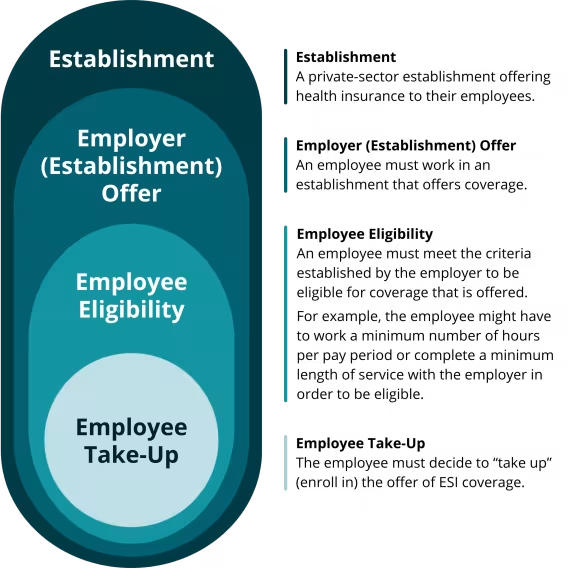
ESI has traditionally been the predominant form of health insurance coverage in the U.S., with a majority of the population—54.6% or about 182 million people—reporting enrollment in ESI coverage in 2024, the latest data year available from the U.S. Census Bureau’s American Community Survey (ACS).
How does SHADAC measure and track ESI?
SHADAC uses data from a survey conducted annually by the Agency for Healthcare Research Quality (AHRQ) – the Medical Expenditure Panel Survey (MEPS). The MEPS is comprised of two main components – the Insurance Component (MEPS-IC), the Health Component (MEPS-HC) – and a third supplement called the Medical Provider Component or MEPS-MPC.
Estimates used in our report and found on our State Health Compare interactive data tool are pulled from the first piece, the Insurance Component. In this survey, employers (both public and private) answer questions on health insurance plans (including how they are purchased and financed), annual premiums and contributions, eligibility, and more.
Current Report
The Struggle to Afford Employer-Sponsored Health Insurance (ESI) in 2024: A 50-State Review
Each year SHADAC publishes a product that provides a national and state-level look at current data and long-term trends in employer-sponsored insurance coverage. These products have taken the form of reports, narratives, infographics, chartbooks, blogs, data tables, and more.
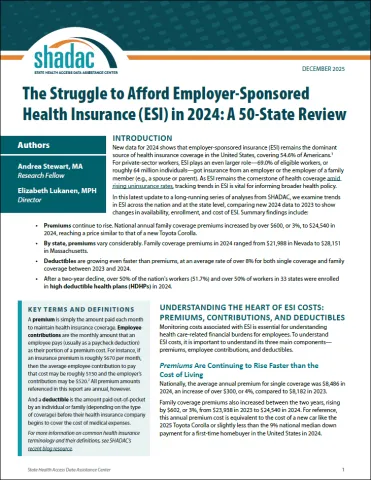
In our most recent report, we took a look at the struggles of private-sector workers to afford ESI coverage, finding that single and family premiums rose by 4% and 3%, respectively, with deductibles rising even faster at a rate of 8% for single coverage and 9% for family coverage.
Other high-level findings include:
Premiums continue to rise. National annual family coverage premiums increased by over $600 to $24,540 in 2024, reaching a price similar to that of a new Toyota Corolla.
By state, premiums vary considerably. Family coverage premiums in 2024 ranged from $21,988 in Nevada to $28,151 in Massachusetts.
Deductibles are growing even faster than premiums, with the average annual deductible for family coverage across the U.S. crossing the $4,000 threshold for the first time in 2024 ($4,063)—a growth of $330 from $3,733 in 2023.
After a two‑year decline, over 50% of the nation's workers (51.7%) and over 50% of workers in 33 states were enrolled in high deductible health plans (HDHPs) in 2024.
As ESI remains the cornerstone of health coverage amid rising uninsurance rates, tracking trends in ESI is vital for informing broader health policy.
Past Reports
State-Level Trends in Employer-Sponsored Health Insurance, 2019-2021
State-level Trends in Employer-sponsored Health Insurance (ESI), 2015-2019
State-level Trends in Employer-sponsored Health Insurance (ESI), 2014-2018
Employer-Sponsored Insurance, 2013-2017: Premiums Grow Faster, Deductibles Continue to Increase
State-Level Trends in Employer-Sponsored Health Insurance: 2016 Report
Specialized Narratives
Infographics
Exploring Cost and Coverage Rates in Employer-Sponsored Insurance
Employer-Sponsored Insurance (2019-2021): A National-Level Look at Cost and Coverage Rates
Employer-Sponsored Insurance, 2014-2018: Premiums Reach New Heights while Deductibles Hold Steady
Employee Health Plans at Large Firms Paid for Smaller Portion of Medical Expenses in 2016
Access ESI Data: Create and Download Maps, Charts, Data Tables, and More on State Health Compare
Many of the data on trends in ESI can be found on State Health Compare—SHADAC’s free and interactive data tool that allows users to explore a variety of health measures, download national and state-level data, and easily generate data visualizations.
Five direct measures on SHC allow users to explore and download overdose and/or ESI data:
Workers in Establishments that Offer Coverage
This measure presents annual state-level data on the overall percentage of private-sector employees covered by a health insurance plan offered by their employer. Data can be broken down by employer (firm) size. This data comes from the Medical Expenditure Panel Survey – Insurance Component (MEPS-IC) fielded by the Agency for Healthcare Research and Quality (AHRQ).
Estimates for this measure pertain to private sector workers who receive health insurance through their employer and have a deductible (the set amount of money enrollees must pay out of pocket before the plan begins to pay for covered health services). Data are available for single plans and family plans and are based on findings from the Medical Expenditure Panel Survey – Insurance Component (MEPS-IC).
This measure shows the average annual premium (the amount paid monthly or annually to maintain health insurance coverage) for private sector workers who receive health insurance through an employer. Data come from the Medical Expenditure Panel Survey – Insurance Component (MEPS-IC) and can be stratified by plan type (either single plans or family plans).
Employee Contributions to Premium
In the case of ESI, the cost of a health plan premium is split between the employer and the employee. This data provides the measure of employees’ contributions to annual premiums for single plans and family plans. Data are collected from the Medical Expenditure Panel Survey – Insurance Component (MEPS-IC).
State Health Compare provides annual, state-level rates of high deductible health plan (HDHP) enrollment based on findings from Medical Expenditure Panel Survey - Insurance Component (MEPS-IC). Estimates for HDHPs, which are simply health plans designed to have lower monthly premiums and a higher deductible, are available beginning in 2012 and can be broken down by firm size (e.g., fewer than 50 employees, greater than 50 employees).
Many other measures on State Health Compare also offer the portion of the U.S. population with ESI as breakdown under types of coverage. Measures that offer ESI coverage subpopulations include: Health Insurance Coverage Type; People with High Medical Care Cost Burden; Adults Who Forgo Needed Medical Care; Trouble Paying Medical Bills; and Adult Cancer Screenings.
ESI in Context: Health Insurance Coverage and Affordability
SHADAC’s ESI report is a part of our Survey Data Season series where we examine health insurance coverage data from five surveys that are released annually from the summer through early fall – the National Health Interview Survey (NHIS), the Behavior Risk Factor Surveillance System (BRFSS), the Current Population Survey (CPS), the American Community Survey (ACS), and the Medical Expenditure Panel Survey – Insurance Component (MEPS-IC), the latter of which is the source for the data in the ESI report.
Learn more about those resources and how ESI fits into the overall health insurance coverage landscape here.
Health care costs and affordability are understandably at the forefront of consumer concerns as numerous sources (reports, studies, surveys, etc.) show rising health care spending and increased medical debt across the nation. SHADAC also uses the data found in the ESI report to better understand issues of health care affordability for consumers. Because ESI is the most prevalent form of coverage in the U.S., understanding and examining the financial components of this type of coverage is a great way to understanding overall rising health care costs impacting the population through an analysis of ESI’s key cost-related components: premiums – and the portion of that cost that is contributed by employees, as well as deductibles – and the portion of employees who are enrolled in high-deductible health plans (HDHPs).
Learn more about those resources and how ESI fits into SHADAC’s expertise on affordability issues expertise on affordability issues here.
ESI Coverage in the Media
2025-2026
- MSN: Sticker Shock: Health Insurance Costs Crush Inflation As Families Face $4,000 Deductibles
- AOL: Sticker Shock: Health Insurance Costs Crush Inflation As Families Face $4,000 Deductibles
Hartford Business Journal: The state’s health sector faces strong headwinds in 2026
Radio Iowa: Study: Many Iowans’ health insurance premiums fell in recent years
Ottumwa Radio: Study: Many Iowan’s health insurance premiums fell in recent years
- KIWA-AM: Study: Many Iowan’s health insurance premiums fell in recent years
- KJAN-FM: Study: Many Iowan’s health insurance premiums fell in recent years
Medical Economics: Why patients with employer-sponsored insurance may struggle to afford it
Oregon Live: Employer health insurance costs reach record highs in Oregon
WZMQ19: Study finds rising employer health insurance costs in Michigan match national trends
Insurance News Net: Costs for employer-based health insurance outpaces inflation
K2 Radio: Workers In Wyoming Face Surging Costs For Health Coverage
TechTarget: Employer-sponsored insurance costs outpaced inflation in 2024
Open Minds: Costs For Employer-Sponsored Health Insurance Plans Outpace Inflation Nationally
Healthcare Payers: Employer-sponsored insurance costs outpaced inflation in 2024
MedCity News: Report: Employer-Sponsored Health Insurance Costs Jumped in 2024, Outpacing Inflation
- Deal Breaker: Employer-Sponsored Health Insurance Costs Jumped in 2024, Outpacing Inflation
- Rama on Healthcare: Report: Employer-Sponsored Health Insurance Costs Jumped in 2024, Outpacing Inflation
Becker's Payers Issues: 5 notes on employer-sponsored insurance affordability across the country
GoozNews: The coming health care meltdown
The National Memo: With System’s Looming Implosion, Health Care Could Dominate 2026 Elections