

Basics Blog
SHADAC has created a series of “Basics Blogs” to familiarize readers with common terms, concepts, and topics that are frequently covered. See all Basics Blogs here.
Since the COVID-19 pandemic, telehealth use has exploded. But what is “telehealth”? And is it different from “telemedicine” and “telecare,” terms which are often used interchangeably?
In this blog, SHADAC experts will explain the definitions of telehealth vs telemedicine vs telecare and the impacts of the COVID-19 pandemic on its utilization. We also discuss some of the benefits and limitations of telemedicine as a method to improve access to care.
Telehealth vs Telemedicine vs Telecare: Definitions
According to the FCC, the word “telehealth” actually evolved from the word “telemedicine,” with both terms becoming more common in the 1960s and 1970s when education, research, and improvements in telehealth and telemedicine services made large advancements at both state and federal levels.
For instance, in 1967, the University of Miami in Florida made advancements in telemedicine by aiding firefighters in transmitting electrocardiographic rhythms over radio to a local hospital for clinician monitoring during rescue situations. And during the 1970s, NASA worked to further telehealth research by partnering with Indian Health Services on the STARPAHC project, which broadly aimed to provide better access to medical care for the Papago Tribe (now known as the Tohono Oʼodham, or “Desert People”) in Arizona and NASA astronauts in space through the development and testing of mobile health units and remote health monitoring, consultation, and education sessions with clinicians.
The intertwined development of telehealth, telemedicine, and telecare means that these terms are often confused with one another or used interchangeably, but their definitions highlight the distinct differences between each.
Telehealth
The Health Resources and Services Administration (HRSA) defines telehealth as “the use of electronic information and telecommunication technologies to support long-distance clinical health care, patient and professional health-related education, health administration, and public health.”
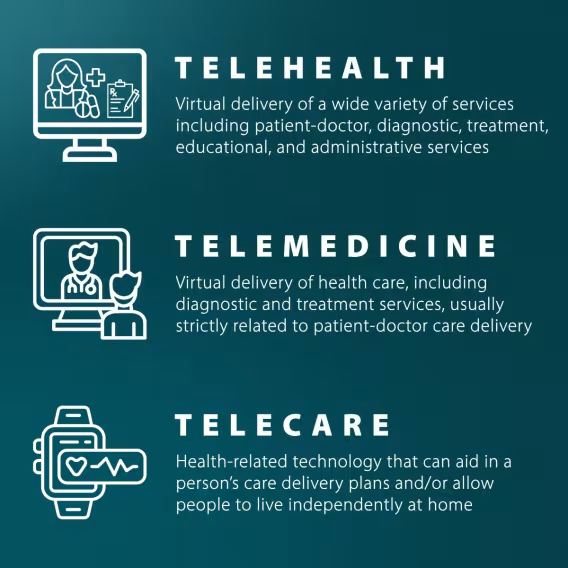
The Federal Communications Commission (FCC) defines telehealth as a wide variety of “remote healthcare services beyond the doctor-patient relationship,” including “services provided by nurses, pharmacists or social workers.”
Telemedicine
Telemedicine is defined by the FCC as “using telecommunications technologies to support the delivery of all kinds of medical, diagnostic and treatment-related services usually by doctors.” Put simply, telemedicine is the virtual delivery of health care, including diagnostic and treatment services, usually strictly related to clinician-patient care delivery.
Thus, telemedicine has a bit more of a specific definition compared to telehealth. While telehealth is defined broadly as virtual delivery of services including patient-clinician, diagnostic, treatment, educational, and administrative services, telemedicine specifically refers to care provided directly by a doctor or other clinician to a patient.
Telecare
Telecare generally refers to “technology that allows consumers to stay safe and independent in their own homes,” for example, “consumer-oriented health and fitness apps” or “sensors and tools that connect consumers with family members or other caregivers,” can be considered as using telecare, according to the FCC.
Therefore, telecare refers to health-related technology that can aid in a person’s care delivery plans and/or allow people to live independently at home. However, telecare is often used synonymously for telemedicine and telehealth, particularly in Europe. Unlike telehealth and telemedicine, there is less documentation on the history of telecare, as it is generally a newer phenomenon due to its reliance on medical technologies.
The Impact of COVID-19
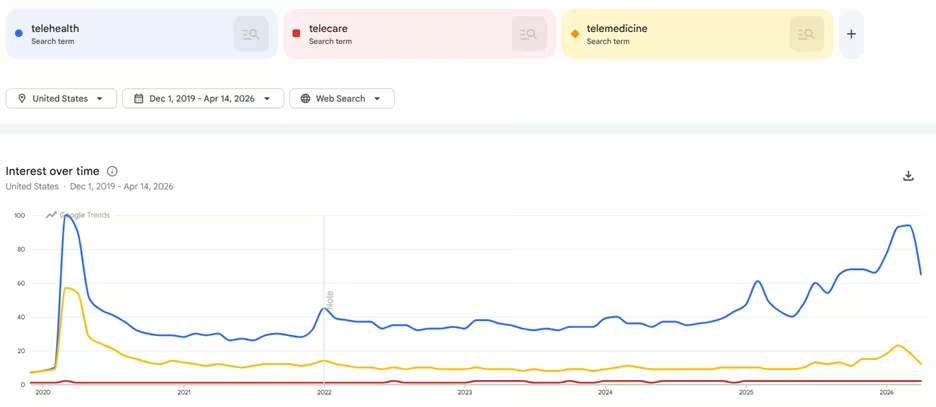
Telehealth and telemedicine gained considerable traction during the COVD-19 pandemic, when it was sometimes the safest, or only way to get health care.1 Google Trends shows that searches for telehealth and telemedicine were at their highest around March 2020—when the pandemic was officially declared by the World Health Organization (see Figure 1 below).^ There was also a spike in searches in 2026, which may have been related to federal regulation passed in late February, 2026, that extended the coverage of telehealth services by Medicare through December 31, 2027. Searches for telecare on Google stayed extremely low over the past six years, with only minimal peaks and dips.
Figure 1. Frequency of Google Web Searches for “Telehealth,” “Telemedicine,” and “Telecare” in 2020–2026, United States
Source: Google Trends. “Telehealth Telecare Telemedicine Search Terms Dec 1 2019 to Apr 14 2026.” Accessed April 14, 2026 from, https://trends.google.com/explore?q=telehealth%2Ctelecare%2Ctelemedicine&date=2019-12-01%202026-04-14&geo=US
Data from Google searches can be helpful in understanding how often people are looking for information about telemedicine, but it is also important to look at trends in the use of these services.
SHADAC’s telehealth measure on State Health Compare tracks the percentage of adults “who had a medical appointment by video or phone in the past year.” The estimates combine two years of data so that the sample size is large enough to be able to report state estimates. In the 2020-2021 period, which includes the peak of the pandemic, nearly one third (31.6%) of people in the U.S. reported that they had a medical appointment by video or phone in the past year. By the 2022-2023 period, which includes the timeframe when the WHO declared the end of the pandemic, the rate had dropped to just over a quarter, or 25.5%.
Benefits and Limitations of Telehealth, Telemedicine, and Telecare
Telehealth, telemedicine, and telecare as vehicles for health care delivery to individuals and populations can each come with their own unique benefits, as well as limitations.
One of the most notable benefits is the accessibility that virtual delivery of care offers people. As referenced above, these modes of care delivery, particularly telemedicine, are particularly beneficial to those living in rural areas, where public modes of transportation are more limited and travel to a clinic more often depends on access to a car, which may be costly. Telemedicine is also important to provide access to providers that are located too far away from rural residents to be accessible by car.2
This accessibility also extends to some people with disabilities as telemedicine and telehealth can provide easier access to health services. For example, those with physical disabilities who find travel difficult or their local clinic inaccessible might find it easier and more accessible to attend appointments virtually.2 Similarly, telecare can help people with disabilities be independent in their own homes.
However, using certain types of telemedicine (for example, video visits or getting access to test results through an online portal) also requires access to technology and high speed internet that can be a barrier for some. SHADAC monitors access to broadband internet through State Health Compare using data from the American Community Survey. While broadband internet access across the country has been becoming increasingly available, state rates can vary considerably. For instance, broadband internet rates in 2024 ranged from 88.6% in to 95.8% in New Hampshire, and people with lower incomes are less likely to have access to broadband.
More about the measure and how its data has changed over time can be found in an upcoming blog by SHADAC researchers. Stay tuned for more!
In addition to technology, there may be other important barriers to the use of telemedicine. For example, someone with a communication-related disability (i.e., someone who is deaf or hard of hearing) may find virtual communication more difficult, or impossible, compared to in-person communication. Financial accessibility should also be considered; for example, certain telecare devices or services may not be covered by insurance, or someone may not be able to afford internet access or a computer.1,2 These barriers are important to understand when evaluating future policies around telemedicine as a way to improve access to care.
Conclusion and Future Considerations
While telehealth, telemedicine, and telecare are often used interchangeably, they all describe different aspects of remote health care delivery:
- Telehealth: the long-distance delivery of care to a patient, ranging from clinical care and pharmaceutical services to administrative assistance.
- Telemedicine: the long-distance delivery of diagnostic or treatment care by a doctor or other clinician to a patient.
- Telecare: the use of health technologies to support independent, at-home living and optimal access to health care.
These modes of health care delivery were vital during the COVID-19 pandemic. With the expansion of artificial intelligence (AI) and its increasing application in health care, telehealth, telemedicine, and telecare will continue to evolve, and SHADAC will continue to monitor these changes and their impacts on health care access and utilization.
Explore telehealth data yourself on State Health Compare. You can download and create data visualizations, maps, tables, and more by state and a number of demographic subgroups to do your own analysis on telehealth and a number of other public health measures—check it out here.
Notes and Sources
^ Note that Google Trends only provides data on searches on Google’s search engine and does not include data on searches from other search engines, which may have different results and trends.