
2026 marks the 30th year of the California Health Care Foundation (CHCF), what they call their “30 Years of Impact.” CHCF’s work to understand and improve health care for Californians across the state has spanned numerous key topics in health policy and public health, including Medi-Cal policy, maternal health, workforce development, and health equity.
SHADAC has worked with CHCF on numerous publications, research analyses, and resources over the years, with the work evolving along with policies, events, and issues. To honor CHCF’s 30th anniversary, this post will highlight a small sample of SHADAC/CHCF projects spanning the last 10 years.
2016—Two Years after ACA Implementation in California: Coverage Gains Continued, Fewer Affordability Concerns Cited
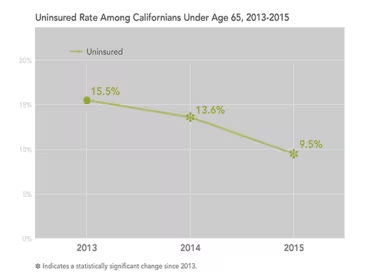
After the implementation of the Affordable Care Act (ACA), many states, public health professionals, and policymakers wanted to understand its impacts, perhaps particularly on the uninsured rate.
SHADAC worked with CHCF to analyze 2013–2015 California Health Interview Survey (CHIS) data, with the analysis finding that the uninsured rate in CA “dropped by six percentage points, from 15.5% in 2013 to 9.5% in 2015, a historic low for California.”
Not only did almost all racial/ethnic and income groups experience coverage gains, but the analysis also found that cost was less likely to be the reason that Californians went without needed health care.
See some of the other findings in this SHADAC/CHCF blog from 2016.
2021—Anticipating and Addressing Coronavirus Vaccination Campaign Challenges at the National and State Level Using Flu Vaccination Data
As we moved forward into the peak of the COVID-19 pandemic in 2020 and 2021, researchers across the globe were working to rapidly produce and distribute a vaccine for COVID-19.
Once vaccines are developed, though, new questions emerge: How can governments, public health professionals, researchers, and health care workers structure vaccination campaigns to work towards protective immunity efficiently and effectively? What sorts of challenges or barriers might arise at the national and state levels? What can we do to anticipate and address vaccination campaign challenges?
In this SHADAC/CHCF study published in January 2021, we analyzed flu vaccine patters across multiple years using Behavioral Risk Factor Surveillance System (BRFSS) data, gaining valuable information on flu vaccination trends nationally, by state, and by demographic group. Essentially, the research team used flu vaccine trends as a proxy to anticipate, and address, COVID-19 vaccination challenges that could arise in the efforts to achieve population-level protective immunity—check out the details of this study here.
2023—Opportunities to Learn More About Serving Justice-Involved Individuals Through 1115 Demonstration Evaluations
In 2023, CMS provided states with new guidance for opportunities to utilize “1115 demonstration projects to improve care transitions for incarcerated individuals.”
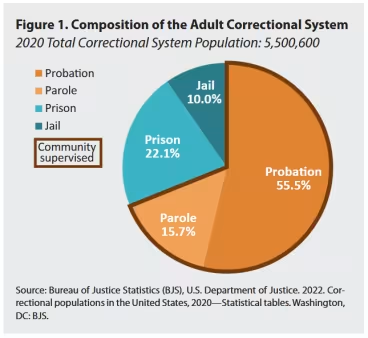
Section 1115 Demonstration Waivers, also sometimes called Section 1115 Transformation Waivers or Section 1115 Medicaid Demonstration Waivers, can be used by states to test new and innovative policies in their Medicaid programs.
In this SHADAC/CHCF brief also from 2023, we reviewed justice-involved 1115 initiatives and proposals, and we summarized existing evaluations of such activities; we also provided recommendations for designing evaluations of initiatives specific to justice-involved individuals.
Some of our key recommendations for evaluations of 1115 justice-involved initiatives include:
- Centering voices of those with lived experience
- Collecting robust data both to monitor and to build evidence in a relatively new topic area
- Considering additional outcome measures beyond ‘typical’ ones
Read the rest of our recommendations and learn more about how we arrived at those recommendations in the full report here.
2024—Language Barriers and Health Equity: The Challenges Faced by Californians with Limited English Proficiency
A number of studies have shown that the Limited English Proficiency (LEP) population is vulnerable to challenges and disparities related to health care access, use, and outcomes compared to English-proficient individuals.
This issue is perhaps particularly prevalent in California: According to California Health Interview Survey (CHIS) data, CA has up to 6.2 million adults* with Limited English Proficiency (LEP). In fact, 25% of people age five and older with LEP in the U.S. reside in California.
To better understand how the LEP population in California experiences and interacts with the health care system, this SHADAC/CHCF study used 2021 and 2022 CHIS data to analyze health care coverage, access, and use in the LEP community. Some key findings include that people with LEP:
- Are more likely to be uninsured, have lower incomes, or be enrolled in public health insurance (e.g., Medicaid)
- Have trouble understanding providers with 29% relying on family or friends to help them understand providers
- Often report fair or poor health status and that they experience discrimination
Read the full study with all of our findings, and a discussion of policy implications and areas for future research, on our website here.
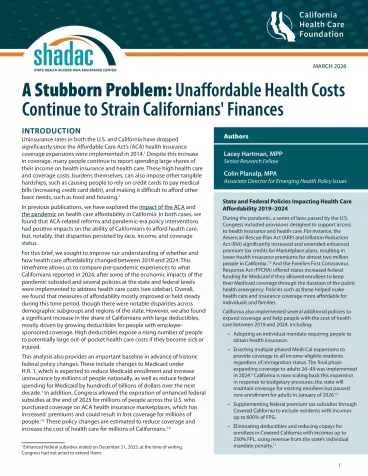
2026—California Health Care Costs: Unaffordable Health Costs Continue to Strain Californians’ Finances
This brings us up to the present with our latest collaborative work with CHCF focused on one of the top issues of the modern health policy landscape: unaffordable health costs.
This study, published in March 2026, examined CHIS data from 2019 to 2024 to understand health care costs in the state as well as how these costs and overall health care affordability might have changed over time. Researchers also examined Current Population Survey data to be able to compare California to the U.S.
Examined measures include the share of Californians with large deductibles (over $2,000), the share reporting having trouble paying medical bills, and the share report high medical cost burden (i.e., spending more than 10% of income on health care costs).
Besides finding that the percentage of people with large deductibles increased, particularly those with employer-sponsored insurance, authors also found that disparities persisted across measures by income, race/ethnicity, coverage type, and state region.
Learn more and read the full study here.
Stay Up-to-Date on the Latest SHADAC/CHCF Releases
From the early days of ACA implementation to some of the latest findings on health care affordability, this blog represents just a sample of the great work that SHADAC has gotten to do alongside CHCF.
The work continues—to hear about all of the latest publications and resources from CHCF and SHADAC, sign up for:
You can also follow SHADAC and/or CHCF on LinkedIn for more frequent updates of our latest work.
*Depending on the definition of LEP applied, CA has between 2.8 and 6.2 million adults with Limited English Proficiency, according to CHCF.