
U.S. Overdose Death Rate Dropped Nearly 30% in Two Years, Driven Largely by Decline in Fentanyl Fatalities
Cocaine and Methamphetamine Account for a Growing Share of Drug Overdose Deaths
Since their rapid ascent and tragic peak during the COVID-19 pandemic, U.S. drug overdose deaths have dropped precipitously.[1] In 2024, just under 80,000 lives were lost to fatal overdoses. While still historically high, that represents a dramatic decline after more than 100,000 deaths a year in 2021, 2022, and 2023.[2]
The decline in overall drug overdose deaths has been driven primarily by a reduction in fatal overdoses involving fentanyl and related synthetic opioids, a class of drugs that has emerged as the center of gravity in the U.S. opioid epidemic in recent years.[3] Between 2022 and 2024, fatal overdoses involving fentanyl and related synthetic opioids declined from a high-water mark of nearly 74,000 to fewer than 48,000—a drop of 35%.
It is not entirely clear why drug overdose deaths have declined so quickly. One possibility is individual-level behavior changes, such as fewer people using drugs or more people using drugs in ways aimed at reducing risks, such as avoiding injection in favor of smoking as a mode of administration.[4] Another possibility is that public health interventions, such as expanding access to evidence-based treatments for opioid use disorder (OUD) and widespread distribution of the opioid overdose-reversing medication naloxone, have begun to pay dividends.[5]
Additionally, some recent research has suggested that the supply of illicitly manufactured and trafficked fentanyl has been constrained, perhaps a result of U.S. and international policymakers’ efforts to hamper supply chains for illicitly trafficked fentanyl.[6]
However, we should also recognize that the U.S. drug crisis is not remotely over. In fact, there are various signs that continued success in reducing drug overdose deaths may become increasingly difficult to achieve, as drug markets evolve, demographic patterns shift, and drug traffickers adapt. For instance, as fentanyl emerged as a growing public health threat in recent years, other non-opioid drugs—especially cocaine and methamphetamine—became intertwined in drug trafficking and the overdose crisis, killing record numbers of people, as well.[7]
Another issue is that there are indications that drug traffickers have been innovating in ways that could undermine recent progress. For instance, in some parts of the U.S., drug traffickers have been adding the non-opioid animal tranquilizer xylazine to fentanyl and other substances, which can cause a variety of new challenges, such as overdoses that cannot be reversed with naloxone.[8],[9],[10]Additionally, public health and law enforcement officials have raised concerns about the emergence of new kinds of illicit synthetic opioids, including nitazenes and orphines, which can be much more potent than fentanyl.[11],[12]
Important to acknowledge for this analysis is that the United States’ outdated vital statistics data infrastructure makes the identification of emerging drug threats to public health challenging to quantify—and challenging to mitigate—until they develop into full-blown crises.[13]
Using mortality data from the U.S. National Vital Statistics System, obtained through the U.S. Centers for Disease Control and Prevention’s (CDC) WONDER database, this analysis examines U.S.-level trends and patterns in fatal drug overdoses. It provides an overview of trends since 2011, when the CDC first declared a drug overdose “epidemic,” with a particular focus on how the crisis has evolved since fatal overdoses peaked in 2022.
We have also written two additional blogs that accompany this analysis: one examining how overdose deaths vary across states and another analyzing variation in overdose deaths by demographic groups.
Recent Trends in the Opioid Epidemic
For roughly a quarter-century, the U.S. has experienced a long-term trend of growing drug overdose deaths. The crisis began relatively slowly and quietly, driven primarily by a steady uptick in fatal overdoses caused by prescription opioid painkillers, such as OxyContin.[14]
Around the time the CDC first declared an overdose “epidemic” in 2011, the dynamics began to change, with a pivot away from prescription opioid painkillers toward illicitly trafficked heroin.[15] Some experts attribute this change, in part, to efforts to mitigate the crisis through interventions such as reducing prescribing of opioid painkillers by health care providers and reformulation of these medications to deter abuse.[16]
The rise of heroin was then followed by the arrival of fentanyl and similar synthetic opioids in the illicit drug market, likely an innovation by illicit drug traffickers to capitalize on relative advantages of the drug. Because fentanyl is typically much more potent than heroin, it can be easier and more profitable to traffic. Additionally, as a synthetic opioid, fentanyl can be manufactured more surreptitiously, without the vast fields of opium poppies required as raw ingredients for producing heroin—a weak link in drug supply chains that are vulnerable to anti-narcotic initiatives by law enforcement agencies.
Since the rise of fentanyl, evidence suggests that drug trafficking organizations also began leveraging their infrastructure to better distribute and market certain non-opioid substances, such as cocaine and methamphetamine, which are often comingled with opioids. Signs of this can be seen in increased seizures by law enforcement agencies of cocaine and methamphetamine alongside fentanyl, as well as in the elevated rates of overdose deaths involving fentanyl combined with cocaine and fentanyl combined with methamphetamine.[17],[18],[19]
Drug users sometimes intentionally use fentanyl together with stimulants such as cocaine and methamphetamine for complementary effects (e.g., a “speedball”). However, people may also find themselves using opioids and stimulants together unintentionally as traffickers accidentally comingle or intentionally mix opioids and non-opioids. For instance, fentanyl is sometimes mixed with cocaine or methamphetamine by drug traffickers at the wholesale- or retail-level, and can be found in counterfeit pills made to resemble medications such as OxyContin and Adderall.[20]
Drug Overdose Deaths in the U.S. in 2024
Vital statistics mortality data show that one of the most recent developments in the opioid crisis is a dramatic drop in fatal drug overdoses.
Between the high-water mark for the overdose crisis in 2022 and the most recently published data from 2024, the U.S. rate for total drug overdose deaths (i.e., fatal overdoses involving all types of drugs) has declined by 29.1% (Figure 1). This was driven largely by a 37.1% decline in the rate of fatal overdoses involving synthetic opioids other than methadone (as shorthand, we will refer to this category as “fentanyl” for the rest of this analysis, as CDC research has found that fentanyl is the most common cause of fatal overdoses in this drug category).[21]
The rate of overdose deaths involving prescription opioids (i.e., natural and semi-synthetic opioids other than heroin) declined by 35.2%, though these are far less common than fentanyl overdose deaths (2.3 deaths per 100,000 people versus 14.3 deaths per 100,000 people in 2024, respectively). The fatal overdose rate for cocaine declined by a smaller 23.5%. The fatal overdose rate for “psychostimulants with abuse potential”—which we will refer to as “methamphetamine” for the rest of this analysis, as CDC research has found that methamphetamine is the most common cause of fatal overdoses in this drug category—declined by a smaller-yet 18.7%.
Figure 1. Fentanyl, Prescription Opioid, Methamphetamine, and Cocaine Overdose Death Rates Per 100,000 People, 2011–2024
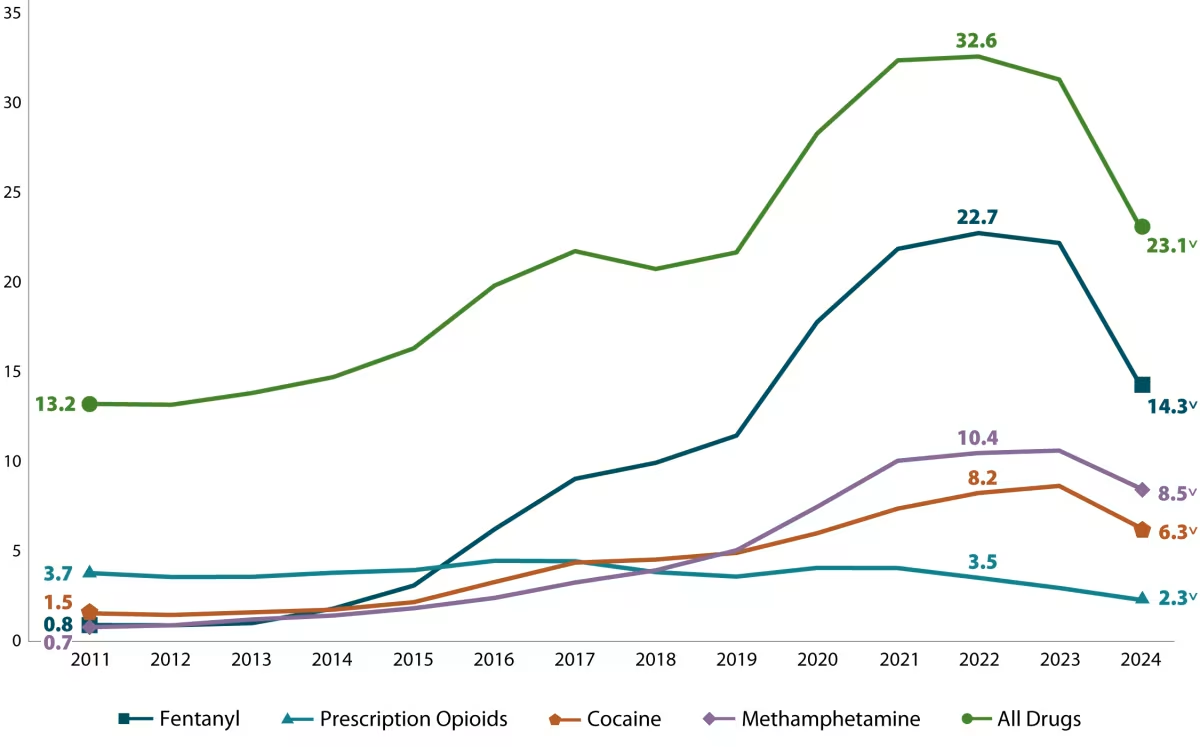
Source: SHADAC analysis of National Vital Statistics System (NVSS) data.
˅ Rate significantly lower than 2022 rate at 95% level
It is important to acknowledge that a large share of fatal overdoses involve multiple drugs, with many involving fentanyl and one or more other substances. For instance, in 2024, 48.1% of prescription opioid overdose deaths also involved fentanyl, 58.8% of methamphetamine overdose deaths also involved fentanyl, and 67.4% of cocaine overdose deaths also involved fentanyl.
As a result of fentanyl and prescription opioid overdose deaths declining more rapidly than those involving other drugs, these two drug categories comprised a smaller share of all drug overdose deaths in 2024 than they did in 2022. Fentanyl fell from representing 69.7% of all overdose deaths in 2022 to 61.9% in 2024, and prescription opioids declined from 10.7% of all overdose deaths to 9.8%.
Conversely, because cocaine and methamphetamine overdose deaths declined more slowly than fentanyl and prescription opioids, they comprised a larger share of all overdose deaths in 2024 than in 2022. Cocaine grew from 25.2% of all drug overdose deaths in 2022 to 27.2% in 2024, and methamphetamine grew from 32.1% of all drug overdose deaths to 36.8%.
Conclusion and Discussion
The U.S. marked a milestone in 2024, with the largest decline in fatal drug overdoses in the past quarter-century, as well as the first time they have dropped for two consecutive years. These developments should be encouraging, as they demonstrate that progress is possible in the effort to turn the tide and save lives.
However, we should be cautious not to declare victory just yet, as the 2024 drug overdose death toll of more than 79,000 lost lives remains historically high—it is, in fact, higher than any time before their spike during the COVID-19 pandemic. We still have far to go before the U.S. drives overdose deaths down to the levels seen before the opioid epidemic began in the late 1990s and early 2000s.
These and other data on drug overdose deaths provide evidence for optimism that the crisis need not be hopeless. But the data presented in this blog—combined with prior experience on the continually evolving nature of the opioid crisis, presented in precursor briefs—point to certain known threats that cannot be dismissed.[22],[23]
One such threat is that the crisis may, yet again, pivot in ways that could allow for a resurgence in overdose deaths, such as when the illicit market for opioids shifted from heroin to fentanyl. Public health and law enforcement agencies throughout the U.S. have continued to identify new and emerging illicit drugs, including novel, powerful opioids that could supplant fentanyl, as well as non-opioids that are increasingly mixed by drug traffickers into the illicit drug supply.
This and other threats and findings underpin a need for continued diligence in tracking changes in overdose crisis trends, as well as state-level variation and differences across demographic subgroups. Though the declines in overdose deaths in 2024 are encouraging, prior experience reinforces that backsliding is possible. But continued tracking and early identification of emerging threats, along with state- and subgroup-level dynamics, can be used by policymakers, public health professionals, the health care system, and others to design and deploy tailored interventions.
While we do not know definitively what has caused the decline in overdose deaths, it is important to acknowledge the recent reversal in the trajectory of the opioid crisis. If for no other reason, noting that improvement reinforces the notion that progress is possible—that saving lives is both a laudable and achievable goal.
The fact that we still do not know why overdose death rates have fallen is concerning, though. It reinforces the idea that the U.S. invest should in research and evaluation efforts to study what has been working to change the course of the crisis, as well as what has not been working, so that policymakers can focus scarce resources on initiatives most likely to pay off by saving and improving people’s lives.
To dive deeper into the latest overdose deaths data, read the two blogs that accompany this analysis:
References
[1] State Health Access Data Assistance Center (SHADAC). (2026). Opioid-related and other drug poisoning deaths per 100,000 people. State Health Compare. https://statehealthcompare.shadac.org/trend/197/opioidrelated-and-other-drug-poisoning-deaths-per-100000-people-by-drug-type#0/1/162/21,19,20,9,10,11,12,13,14,1,2,3,4,5,6,7,8,15,24,25,27,32,37,42,76/233
[2] National Center for Health Statistics. (2026, June 9). Mortality Data on CDC WONDER. Centers for Disease Control and Prevention (CDC) WONDER. https://wonder.cdc.gov/mcd.html
[3] Planalp, C., & Stewart, A. (2024, October). Changing Dynamics in the Opioid Crisis Since the COVID-19 Pandemic. State Health Access Data Assistance Center (SHADAC). https://shadac-pdf-files.s3.us-east-2.amazonaws.com/s3fs-public/2026-03/2024%20Opioid%20Brief_FINAL_0.pdf
[4] Dowell, D., Nataraj, N., Rikard, M., Park, J., Zhang, K., & Baldwin, G. (2025). Why have overdose deaths decreased? Widespread fentanyl saturation and decreased drug use among key drivers. The Lancet Regional Health – Americas, 51, 101226. https://doi.org/10.1016/j.lana.2025.101226
[5] Dowell, D., Nataraj, N., Rikard, M., Park, J., Zhang, K., & Baldwin, G. (2025). Why have overdose deaths decreased? Widespread fentanyl saturation and decreased drug use among key drivers. The Lancet Regional Health – Americas, 51, 101226. https://doi.org/10.1016/j.lana.2025.101226
[6] Vangelov, K., Humphreys, K., Caulkins, J.P., Pollack, H., Pardo, B., & Reuter, P. (2026). Did the illicit fentanyl trade experience a supply shock? Science, 391(6781), 134-136. https://doi.org/10.1126/science.aea6130
[7] Planalp, C., & Stewart, A. (2024, October). Changing Dynamics in the Opioid Crisis Since the COVID-19 Pandemic. State Health Access Data Assistance Center (SHADAC). https://shadac-pdf-files.s3.us-east-2.amazonaws.com/s3fs-public/2026-03/2024%20Opioid%20Brief_FINAL_0.pdf
[8] National Institute on Drug Abuse. (2024, September). Xylazine. National Institutes of Health. https://nida.nih.gov/research-topics/xylazine
[9] United States Drug Enforcement Administration (DEA). (n.d.). Public Safety Alert: DEA Reports Widespread Threat of Fentanyl Mixed with Xylazine. U.S. Department of Justice. https://www.dea.gov/alert/dea-reports-widespread-threat-fentanyl-mixed-xylazine
[10] Kariisa, M., O’Donnell, J., Kumar, S., Mattson, C.L., & Goldberger, B.A. (2023, June 30). Illicitly Manufactured Fentanyl–Involved Overdose Deaths with Detected Xylazine — United States, January 2019–June 2022. Morbidity and Mortality Weekly Report, Centers for Disease Control and Prevention (CDC). https://www.cdc.gov/mmwr/volumes/72/wr/mm7226a4.htm
[11] DEA Washington Division. (2022, June 1). New, Dangerous Synthetic Opioid in D.C., Emerging in Tri-State Area. United States Drug Enforcement Administration (DEA), U.S. Department of Justice. https://www.dea.gov/stories/2022/2022-06/2022-06-01/new-dangerous-synthetic-opioid-dc-emerging-tri-state-area
[12] Office of Justice Programs. (2026). Increase in Fatal Overdoses Linked to Novel Synthetic Opioid N-Propionitrile Chlorphine (Cychlorphine). U.S. Department of Justice. https://www.ojp.gov/library/publications/increase-fatal-overdoses-linked-novel-synthetic-opioid-n-propionitrile
[13] Planalp, C., & Stewart, A. (2024, October). Changing Dynamics in the Opioid Crisis Since the COVID-19 Pandemic. State Health Access Data Assistance Center (SHADAC). https://shadac-pdf-files.s3.us-east-2.amazonaws.com/s3fs-public/2026-03/2024%20Opioid%20Brief_FINAL_0.pdf
[14] Planalp, C., & Lahr, M. (2018, June). The Opioid Epidemic: National Trends in Opioid-Related Overdose Deaths from 2000 to 2016. State Health Access Data Assistance Center (SHADAC). https://shadac-pdf-files.s3.us-east-2.amazonaws.com/s3fs-public/publications/NATIONAL_opioid_brief_2000-2016.pdf
[15] Planalp, C., & Lahr, M. (2018, June). The Opioid Epidemic: National Trends in Opioid-Related Overdose Deaths from 2000 to 2016. State Health Access Data Assistance Center (SHADAC). https://shadac-pdf-files.s3.us-east-2.amazonaws.com/s3fs-public/publications/NATIONAL_opioid_brief_2000-2016.pdf
[16] Pitt, A., Humphreys, K., & Brandeau, M. (2018). Modeling Health Benefits and Harms of Public Policy Responses to the US Opioid Epidemic. American Journal of Public Health, 108(10), 1394-1400. https://doi.org/10.2105/ajph.2018.304590
[17] United States Drug Enforcement Administration (DEA). (2024, May). National Drug Threat Assessment 2024. U.S. Department of Justice. https://www.dea.gov/sites/default/files/2025-02/508_5.23.2024%20NDTA-updated.pdf
[18] United States Drug Enforcement Administration (DEA). (2025, May). National Drug Threat Assessment 2025. U.S. Department of Justice. https://www.dea.gov/sites/default/files/2025-07/2025NationalDrugThreatAssessment.pdf
[19] Office of Forensic Sciences, Special Testing and Research Laboratory. (2025, July 18). CY 2024 Annual Cocaine Report. United States Drug Enforcement Administration (DEA). https://www.dea.gov/sites/default/files/2025-09/CY2024%20Annual%20Cocaine%20Report%20PRB-2025-42%20Final.pdf
[20] United States Drug Enforcement Administration (DEA). (2026, June 8). One Pill Can Kill. U.S. Department of Justice. https://www.dea.gov/onepill
[21] Spencer, M.R., Warner, M., Cisewski, J.A., Miniño, A., Dodds, D., Parera, J., & Ahmad, F.B. (2023, May). Estimates of Drug Overdose Deaths Involving Fentanyl, Methamphetamine, Cocaine, Heroin, and Oxycodone: United States, 2021. Vital Statistics Rapid Release Report No. 27. National Center for Health Statistics. https://www.cdc.gov/nchs/data/vsrr/vsrr027.pdf
[22] Planalp, C., & Stewart, A. (2023, November). The Opioid Crisis in the Pandemic Era. State Health Access Data Assistance Center (SHADAC). https://shadac-pdf-files.s3.us-east-2.amazonaws.com/s3fs-public/publications/Opioid%20Crisis%20Pandemic-2023%20Brief.pdf
[23] Planalp, C., & Stewart, A. (2024, October). Changing Dynamics in the Opioid Crisis Since the COVID-19 Pandemic. State Health Access Data Assistance Center (SHADAC). https://shadac-pdf-files.s3.us-east-2.amazonaws.com/s3fs-public/2026-03/2024%20Opioid%20Brief_FINAL_0.pdf