

This post is a part of our Survey Data Season series where we examine data from various surveys that are released annually from the summer through early fall. Find all of the Survey Data Season series posts on our Survey Data Season 2026 page here.
Health insurance coverage providers play a foundational role in how health care is delivered and accessed across the nation. While individuals and families in the United States can access health insurance coverage through a number of different pathways (e.g., public coverage such as Medicaid, Marketplace coverage, employer-sponsored insurance), a lot of health insurance terminology is the same across types of coverage.
To build upon our previous blog post defining some common insurance terms like premiums and copays, this article reviews and defines additional health insurance terminology to help readers understand foundational concepts in health policy and insurance.
Health Insurance Utilization and Medical Treatment Terminology
To begin, we will review terms related to health insurance utilization and medical treatment terms related to health care utilization.
Health Insurance Benefits vs. Services
A service in health insurance is defined as the actual care or equipment that a patient receives, such as an office visit, a lab test, an MRI, a medical device, or a prescription.
A health insurance benefit, on the other hand, is what a plan says it will cover for a service, and how. For example, a plan may say that “annual wellness visits are covered at no cost” or “this plan does not include adult dental benefits.”
Essential Health Care Benefits
Before the passage of the Affordable Care Act, health insurance benefits in the U.S. varied widely between insurance plan types, and some plans offered little or no coverage for services like maternity care, substance use treatment, mental health services, or prescription drugs.
This changed with the passing of the Affordable Care Act and its mandated Essential Health Benefits (EHBs). Sometimes called essential health care benefits, EHBs are defined by the Centers for Medicare & Medicaid Services (CMS) as, “a set of 10 categories of services that health insurance plans must cover under the Affordable Care Act.”
These 10 Essential Health Benefits are:
- Outpatient/ambulatory care
- Emergency services
- Hospital stays
- Maternity and newborn care
- Mental health and substance use disorder treatment
- Prescription drug coverage
- Rehabilitative and habilitative care
- Lab work
- Preventive care services
- Pediatric services, including dental and vision care
Since 2014, new individual and small-group health insurance plans have been required to include these 10 benefits, which are modeled on the kind of coverage that the majority of people in the U.S. get through employer-sponsored insurance (ESI) plans. When plans cover these 10 categories of services, it is considered “comprehensive coverage.”
Table 1. Examples of Benefits and Corresponding Services
Benefit | Example Corresponding Services |
|---|---|
Maternity and Newborn Care | Prenatal Visits, Labor and Delivery, Newborn and Postpartum Care |
Preventive Services | Cancer Screenings, Depression Screenings, Immunizations |
Outpatient/Ambulatory Care | Office Visits, Kidney Dialysis, Outpatient Surgery |
Ultimately, the Secretary of the Department of Health and Human Services determines the scope of the Essential Health Benefits, but does not specify which services fall under those benefits. Each state has the flexibility to select an “EHB Benchmark Plan” that they follow, which determines the services that are included under the mandated benefits. As a result, comprehensive coverage can vary from state to state as each state implements their own benchmark plan and state-required benefits; see the individual EHB-benchmark plans for all 50 states and D.C. on the CMS website.
Many measures of health insurance coverage, health care utilization, and health care access vary by state. Compare data between states and by demographic group on State Health Compare.
Explanation of Benefits
When a patient receives services from a provider and submits a claim to their health insurance, they will usually receive a document called an Explanation of Benefits (EOB). The EOB explains how much both the patient and their insurer owe for services provided, and how their benefits apply to those services.
An Explanation of Benefits will include, amongst other information, a service description, provider charges, the amount to be paid by insurance, and the remaining amount that will be owed by the patient. EOBs are not actually bills: They simply document and explain the service, the charges for the service, and how the amount owed will be split between the insurer and the enrollee.
EOBs might also include information about why a claim may have been denied or adjusted, with information about how to contact the company for an appeal if a patient disagrees with the level of coverage determined by the insurer.
Referral vs. Prior Authorization
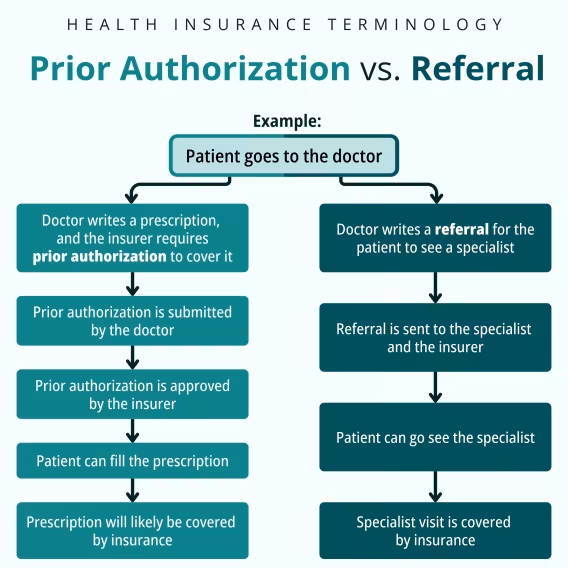
CMS defines a referral as “a written order from your primary care doctor for you to see a specialist or get certain medical services.”
Some insurance plan types require referrals before services beyond primary care are covered; referrals are issued by the patient’s doctor, usually their primary care doctor. Without getting a referral before seeing a specialist or receiving services, certain types of insurance plans may not cover or pay for services; it is important for enrollees to check the specific guidelines of their plan to see if referrals are required to see a specialist or receive services beyond primary care.
Issuing a referral allows specialized care providers access to a patient’s historical medical information, which can help streamline the creation of a treatment plan.
Prior authorization—also known as “prior approval” or “preauthorization” or a “PA”—refers to approval from a health plan before specific services may be accessed or delivered. In other words, certain services or treatments require prior approval (a “prior authorization”) from a patient’s health insurer in order to have that service covered by the patient’s plan.
While getting a PA approved does not guarantee coverage, it makes it much more likely that the insurer will cover the cost. Prior authorization is often required when seeking reimbursement for higher-cost services, such as certain surgeries or types of medical equipment.
Usually, a patient’s doctor will submit the prior authorization for a service by submitting medical records and details about the desired service(s) to the insurance provider. The insurer then reviews the request and either authorizes or denies it based on their assessment of medical necessity, safety, and cost. If denied, the doctor and patient can appeal the decision.
Learn more about the impacts of chronic disease on health in this blog from SHADAC.
So, what is the difference between a prior authorization and a referral? Both refer to orders or approvals needed before an enrollee can receive coverage for a service, but they differ in who is doing the approval or order.
Referrals are written orders or approvals provided by a patient’s doctor, which is required by some plans to cover certain services. A prior authorization, on the other hand, is submitted by a patient’s doctor or medical team to their insurance company for approval, with the insurer deciding whether the requested service is approved or denied for coverage.
Health Insurance Costs and Financial Terminology
The prior section discussed terms related to how enrollees can access the health care system through services and benefits. This section will define and describe terms related to how enrollees are charged for services, and how health insurance costs are covered by (or shared with) insurance providers.
Billed Charge vs. Allowed Amount
A billed charge is what a provider initially charges for a service they deliver. For example, a therapist may charge $200 per talk therapy session—this bill is sent to insurance.
An allowed amount is a maximum negotiated or contracted rate that an insurer will pay a provider for a service. If the insurer’s allowed amount is less than the billed charge—for example, the allowed amount for talk therapy is $180 but the billed charge was $200—then the patient will owe the difference (in this example, they would owe $20).
Out-of-Pocket Spending
Out-of-pocket spending is the amount a patient spends directly for health care, rather than what insurance pays. It includes cost-sharing, like deductibles, copayments, and coinsurance, as well as the cost of any services than a plan does not cover.
Most plans also have a designated out-of-pocket maximum, which, as we describe in Part 1 of this series, “is the most you have to pay for covered services in a year.” Premiums do not count towards one’s out-of-pocket maximum. Once the out-of-pocket limit is reached, insurance pays 100% of covered costs for the rest of the calendar year.
Out-of-pocket spending can vary by geography and type of coverage. To see how it differs across states, visit State Health Compare, where you can explore state-level estimates of median out-of-pocket medical spending based on SHADAC’s analysis of Current Population Survey (CPS) data.
Let’s look at a quick example from SHC, seeing how out-of-pocket spending varies across the states using SHC’s “Map” feature.
Figure 1. Median Out-of-Pocket Medical Spending by State, Map, 2024
As you can see in the data visualization from SHC above, medical out-of-pocket spending ranges from a high of over $3,600 in North Dakota to lows of $1,000 in New Mexico and Mississippi. Looking at the data visually like this can help reveal regional patterns—as we can see, many states with the highest median medical OOP spending are clustered in the Midwest, including SHADAC’s home state of Minnesota at $3,500.
We’re currently working on updating this measure with the latest CPS data from 2025 (released in September 2026). Read our recent blog for some key takeaways from these new CPS data, and sign up for our monthly newsletter to be notified of the latest SHC updates.
High Medical Cost Burden
As health care spending in the United States continues to rise, some Americans are spending a growing share of their annual income on health-related expenses. On State Health Compare, we define someone has having a high medical cost burden when “out-of-pocket spending accounts for more than 10% of annual income.”
Monitoring rates of high medical cost burden across the country, by demographic group, and over time can help us understand trends in health care affordability, and identify where disparities and gaps might exist. High medical cost burden can lead to medical debt, forgone care due to cost, inability to afford other necessities (e.g., housing, food, childcare).
Explore this measure on State Health Compare here.
Having Trouble Understanding Health Insurance Terminology? SHADAC Is Here to Help
Understanding and navigating the complexities of health insurance plans may feel overwhelming. We hope that the health insurance definitions and explanations we provided in this review help provide clarity for those seeking more information on health insurance and can be a resource for improving health insurance literacy.
Check out part one of our Health Insurance Terminology blog to learn more about common insurance terms like premiums, deductibles, and copays.
Struggling with a term or concept that was not included in Part 1 or Part 2 of this health insurance terminology series? Assistance is in our name—contact us here to ask any questions you still have, or to request a term be included in an upcoming Part 3 of this series.

Basics Blog
SHADAC has created a series of “Basics Blogs” to familiarize readers with common terms, concepts, and topics that are frequently covered. See all Basics Blogs here.