
This post is a part of our Survey Data Season series where we examine data from various surveys that are released annually from the summer through early fall. Find all of the Survey Data Season series posts on our Survey Data Season 2025 page here.
What Is Employer-Sponsored Health Insurance (ESI)?
As the name suggests, employer-sponsored insurance (ESI) is health insurance coverage offered by employers to eligible employees, with coverage options for employee spouses and families. ESI has traditionally been the predominant form of health insurance coverage in the U.S., with a majority of the population—54.6% or about 182 million people—enrolling in ESI coverage in 2024. Looking solely at the private-sector workforce, this figure increases to 69.0% in 2024.
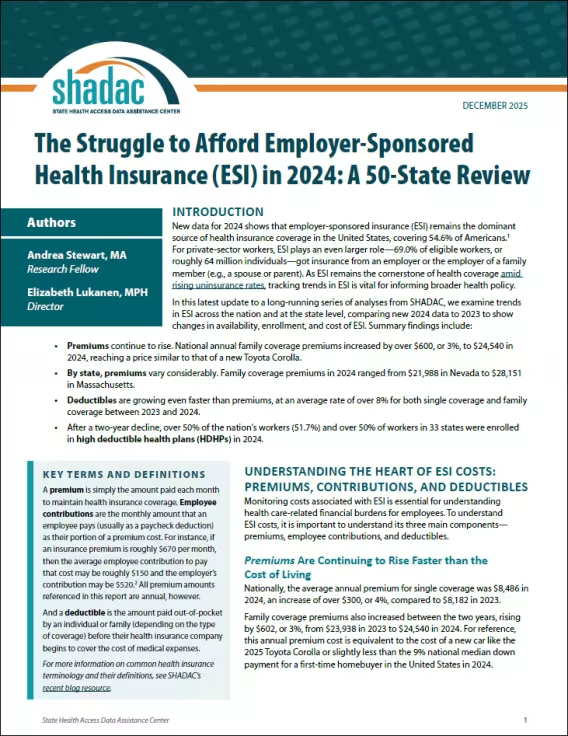
In the latest brief from a long-running series, SHADAC researchers use estimates from the Medical Expenditure Panel Survey-Insurance Component (MEPS-IC), produced by the Agency for Healthcare Research and Quality (AHRQ), to look at national and state-level ESI access, enrollment, and cost data in 2024 as compared to the prior year.
ESI in Context: The Health Insurance Coverage Landscape in 2024
Thanks to recently released federal data from surveys conducted by the U.S. Census Bureau and the National Center for Health Statistics (NCHS) at the Centers for Disease Prevention and Control (CDC), we know that the health insurance coverage landscape in the United States underwent several major shifts in 2024.
For instance:
- Data from the American Community Survey (ACS) showed that uninsured rates rose significantly in 2024, increasing to 8.2% from 7.9% in 2023.
- Data from the National Health Interview Survey (NHIS) found that the percentage of people with public insurance coverage dropped significantly from 40.5% to 39.1%.
- And data from the Current Population Survey (CPS) found that the percentage of the population with private insurance coverage significantly increased to 66.1% last year from 65.4% in 2023.
While it is encouraging that private insurance increased in 2024 as a potential alternative source of coverage for individuals transitioning from public coverage, two concerns remain.
One, that uninsured rates also increased in 2024, meaning that not everyone who transitioned off of public coverage was able to enroll in another form of health insurance.
And two, despite an increase in private coverage, both ACS and CPS data showed that employer-sponsored insurance (ESI) coverage—the most prevalent form of private coverage in the United States—did not correspondingly increase. ESI enrollment remained statistically unchanged from 2023 to 2024, with forms like direct purchase, Marketplace, and TRICARE driving the overall growth in private coverage.
The Brief: A Closer Look at ESI in 2024 Through Enrollment, Premiums, and Deductibles
As the predominant form of coverage in the American health insurance landscape, SHADAC researchers sought to better understand changes in ESI enrollment and cost in 2024 at the national level and across all 50 states.
In addition to examining the percentage of private-sector establishments (employers) that offer ESI coverage to their employees, this brief also includes analysis of the percentage of employees who were eligible for ESI coverage, as well as the percentage of employees who “took up” or enrolled in ESI coverage.
We also look at issues of affordability, as costs associated with gaining access to and retaining ESI coverage have risen consistently over the past decade, outpacing inflation. Measures of these costs include:
- Annual Premiums (both single and family)
- Annual Deductibles (both single and family)
- Enrollment in high deductible health plans (HDHPs)
Access the full report for more detail on national-level trends and to read about which states experienced the greatest changes in ESI costs from 2023 to 2024.
Looking for more information on the “basics” health insurance costs and coverage? SHADAC has you covered: Read our blog reviewing common health insurance terminology, like co-pays, premiums, and deductibles.