
According to a 2025 poll from the Pew Research Center, a majority of respondents (66%) believe that the federal government has a responsibility to ensure that all of the U.S. population has health insurance coverage. While there are many options and strategies that could help expand health insurance coverage rates, one pivotal step for the federal government, policymakers, researchers, and others in this effort is to first understand how much of the population does not currently have health insurance, commonly referred to as the “uninsured rate,” in order to close any existing coverage gaps.
One place that policymakers and researchers might look to find the answer is from large federal surveys conducted by organizations such as the U.S. Census Bureau or the Centers for Disease Control and Prevention (CDC). These surveys estimate uninsurance for the nation and, in some cases, across the states and U.S. territories by asking various questions about insurance coverage, including:
- Whether or not health insurance coverage was held by individuals at the time of the interview or during the past year, or if they were uninsured,
- What type of coverage was held (e.g., employer-sponsored insurance, public coverage, etc.),
- Any gaps in coverage,
- And more (like how health care services were accessed and utilized via health insurance coverage, for example).
Along with providing information on who does not have health insurance coverage, accurate estimates of uninsured rates (also referred to as “uninsurance”) are also important in understanding trends and the impacts of actions (policy changes), events (like public health emergencies), or shifts in the economic landscape (like periods of recession) that may affect health insurance coverage.
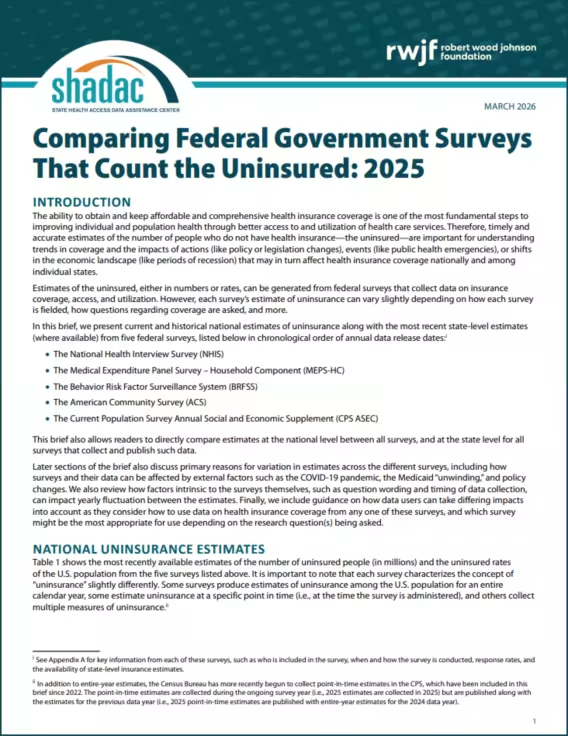
Comparing Federal Surveys That Count the Uninsured 2025
To help data users and other interested persons understand the ways that certain federal surveys work to measure the number of uninsured in the nation, SHADAC produces an annual brief entitled “Comparing Federal Government Surveys that Count the Uninsured.” This brief has now been updated following the releases of 2024 insurance coverage estimates from multiple federal surveys.
Within the brief are the latest estimates of the national uninsured rate, trends in uninsured rates over time (from 2010 onward), as well as the latest state-level estimates (where feasible), from the following five federal surveys:

The American Community Survey (ACS), managed by the U.S. Census Bureau
The Current Population Survey (CPS) - Annual Social and Economic Supplement (ASEC), managed by the U.S. Census Bureau
The Medical Expenditure Panel Survey - Household Component (MEPS-HC), managed by the Agency for Healthcare Research and Quality (AHRQ)
The National Health Interview Survey (NHIS), managed by the National Center for Health Statistics (NCHS)
The Behavioral Risk Factor Surveillance System (BRFSS), managed by the Centers for Disease Control and Prevention (CDC)

We also analyze factors that directly impact variations in these estimates among surveys, such as the surveys’ design and data collection processes, as well as exploring the more indirect impacts of recent events external to the surveys, such as the Medicaid continuous coverage requirement unwinding and the COVID-19 pandemic.
View and download the Comparing Federal Government Surveys 2025 Brief to learn more about our findings and analysis.
Interested in learning more about insurance coverage trends? SHADAC has a number of helpful products, including:
- Comparing Federal Government Surveys That Count the Uninsured: 2024 (last year’s version of this brief)
- The Struggle to Afford Employer-Sponsored Health Insurance (ESI) in 2024: A 50-State Review (a brief which uses survey data from the MEPS to examine trends in coverage and cost for ESI)
- 2024 NHIS Full-Year Health Insurance Estimates Early Release (a blog covering the earliest available estimates of health insurance coverage for the prior year, produced using data from the NHIS)
- Minnesota’s Community and Uninsured Profile (an interactive tool [that can be built for any state!] that provides rates and counts of uninsured Minnesotans at a range of geographic levels and demographic and community characteristics using data from the ACS)
And if you’re interested in understanding more about the language we use to talk about health insurance coverage, SHADAC has produced a clear, concise, and informative guide to common health insurance terms, which includes descriptions and definitions of premiums, deductibles, copays, and more as part of our “Survey Data Season Essentials” series of products.