
In the U.S., people access health insurance coverage through many different pathways, which depends on age, employment status, and income, as well as pregnancy and disability status.
Non-elderly adults aged 18–64, a group that makes up just over 60% of the country’s population, access health insurance coverage through either private or public options; American Community Survey data show the following coverage rates for non-elderly adults in 2024:
- Employer-Sponsored Insurance Coverage: 64.4%
- Employer-subsidized coverage is typically tied to full-time employment
- Marketplace Coverage: 8.9%
- Includes subsidized premium support for income eligible individuals and families
- Public Coverage: 15.5%
- Tax-subsidized Medicaid, the Children’s Health Insurance Program, Medicare, or a state-specific public program based on age, income, and disability status
The remaining 11.2%, or 22.3 million individuals, have no coverage and are considered uninsured.
Disruptions in coverage can occur due to significant life events such as a loss or change in employment, a loss or change in income, marriage, or divorce. For example, losing one’s job can mean losing access to employer-based coverage; increased income can mean loss of eligibility for public coverage.
Coverage may also be affected by legislative or regulatory changes to state and federal health policy. These changes can include coverage criteria for public programs or changing the levels of premium subsidies provided for coverage on the Marketplace.
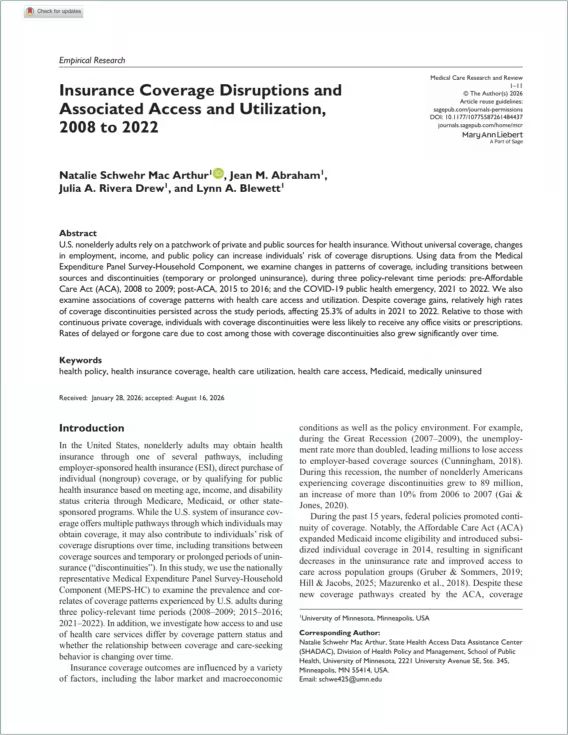
Researchers at the University of Minnesota School of Public Health, including SHADAC Senior Research Associate Natalie Schwehr Mac Arthur, SHADAC faculty affiliates Jean Abraham and Lynn A. Blewett, and IPUMS Research Scientist Julia Drew, wanted to understand changes in patterns of insurance coverage, including transitions between sources and discontinuities (temporary or prolonged uninsurance) and the impact on health care access and utilization.
Using data from the IPUMS Health Surveys Medical Expenditure Panel Survey-Household Component (MEPS-HC), these researchers examined coverage patterns for non-elderly adults during three time periods: Before the implementation of the Affordable Care Act (ACA) (2008–2009); post-implementation of the Affordable Care Act (2015–2016); and during the COVID-19 pandemic (2021–2022).
Keep reading for some of the key findings from this research paper, Insurance Coverage Disruptions and Associated Access and Utilization, 2008–2022, which was just published in Medical Care Research and Review.
Note on Data Source: Using MEPS-HC Data for Health Care Access and Utilization Research
The Household Component of the Medical Expenditure Panel Survey (MEPS-HC) is a nationally representative, longitudinal survey collected by the Agency for Healthcare Research and Quality annually from 1996 to the present on topics such as health status, medical conditions, health care utilization, and health care expenditures for the U.S. civilian, non-institutionalized population.
The MEPS-HC is a critical component of the U.S. federal health data infrastructure; the data it produces are critical to monitoring the impact of continued policy changes on health insurance coverage and access to needed care over time.
The MEPS-HC was particularly well-suited for this study because of the survey’s content (e.g., question content, the depth of variables on health care access and utilization) and its two-year panel design. Both features make MEPS-HC data uniquely valuable for understanding the topic of coverage discontinuities over time. The IPUMS-harmonized MEPS-HC (available at meps.ipums.org) made it easy for the research team to analyze multiple years of MEPS-HC data for this study.
Insurance Coverage Disruptions and the Impact on Health Care Access, Utilization: Key Findings
Using MEPS-HC data from three distinct time periods (pre-ACA, post-ACA, during COVID-19 public health emergency), the authors found:
- Overall, continuous health insurance coverage (from any coverage source) increased about 20% from 2008–2009 to 2021–2022
- Despite the increase in coverage rates, coverage gaps remained high in all three study time periods.
- During 2021–2022 an estimated 25.3% of individuals or 49 million adults experienced a temporary or prolonged gap in their health insurance coverage.
- Compared to those with continuous private coverage, those with coverage discontinuities were:
- Less likely to access routine health care (i.e., office visits) and prescriptions
- More likely to report unmet health care needs
- Individuals who reported coverage discontinuities were not only more likely to delay or forgo care relative to those with continuous private coverage, but the size of this effect also grew significantly over time
- Coverage discontinuities were higher among those with lower income and those living in the South
Find More Study Details in Medical Care Research and Review
“While our study and others have shown a significant decrease in uninsurance [post-ACA], […] adults aged 19–64 continued to experience persistent rates of coverage disruptions,” study authors conclude.
“When individuals experience discontinuities in their health insurance coverage, this affects care-seeking behavior with potential negative implications for health outcomes.”
Read the rest of this study’s findings, along with a discussion of methods, framework, results, and implications, in the full paper in Medical Care Research and Review, available here.
Looking for More Information on This Topic?
Check out some other SHADAC publications:
- BRIEF – Insurance Coverage Transitions After the Medicaid Unwinding
- BLOG – Unaffordable Health Care Costs: More U.S. Adults Forgo Care Due to Cost in 2024, Differences Seen by State, Insurance Coverage Type, Chronic Disease Status
- BLOG – 2025 MEPS-IC Data: Rising Health Insurance Costs: Family Employer-Sponsored Insurance (ESI) Premiums Grow at Over Twice the Rate Seen Last Year